

Quick Answer
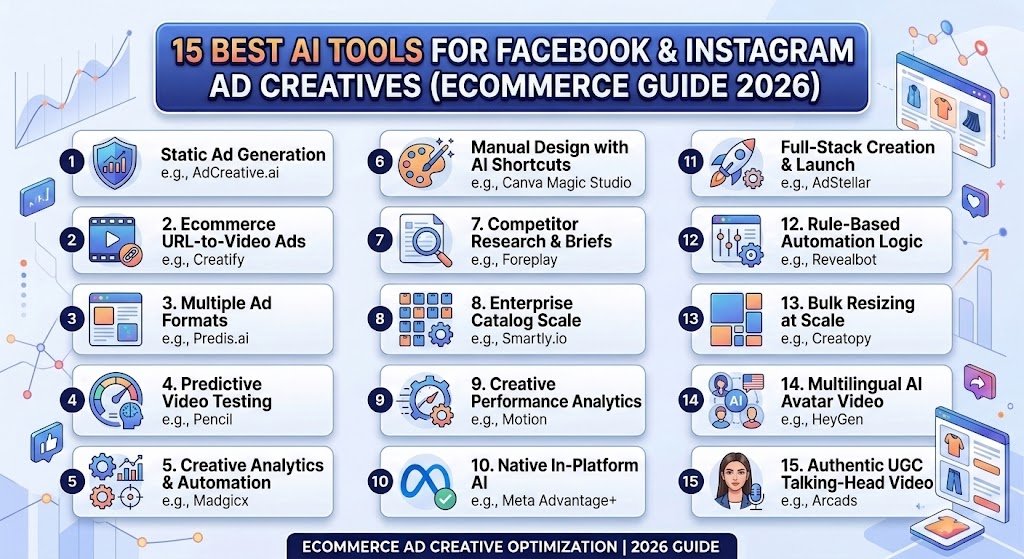
The best AI tools for Facebook Instagram ad creatives ecommerce brands use in 2026 are AdCreative.ai (static ad generation), Creatify (UGC-style video), Pencil (predictive video testing), Madgicx (creative analytics + automation), Canva Magic Studio (manual control with AI shortcuts), and Foreplay (competitor research). No single AI ad generator does everything well, most ecommerce teams pair one creative-generation tool with one testing or research tool to cover the full workflow, from idea to launch to performance review.
Table of Contents
If your biggest bottleneck is producing more ad creatives, start with AdCreative.ai or Creatify. If it’s knowing what to make next, start with Foreplay or Motion. If it’s proving what’s actually working, Madgicx or Motion cover that ground. This guide walks through all 15 tools worth knowing about, what each one does best, real starting prices, and where each one falls short.
Why Ad Creative Is the Real Bottleneck for Ecommerce Meta Ads in 2026
Targeting used to be the hard part of running Facebook and Instagram ads. That’s no longer true. Meta’s Advantage+ system now automates most audience targeting decisions, which shifts the entire burden of ad performance onto one thing: creative.
Meta’s own research shows creative quality drives the majority of auction outcomes more than bidding, placement, or targeting combined, according to Meta’s advertiser guidance on creative performance. Audiences also fatigue fast. Most Meta ad sets need 15–25 fresh variants a week to avoid creative fatigue, and CPMs can climb 30–40% within 72 hours once an audience has seen the same static ad or video ad too many times.
That’s exactly the gap AI tools for Facebook Instagram ad creatives ecommerce brands now rely on to close. Instead of waiting days for a designer, video editor, or agency, a product photo or product URL can become a finished, launch-ready Meta ad creative in minutes. This guide breaks down which AI ad creative software actually delivers on that promise, what it costs, where it breaks, and how to build a full creative-testing workflow around it, not just pick one tool and hope it covers everything.
Key takeaway: Ecommerce ad performance on Meta in 2026 depends less on who can target better and more on who can test more ad creative, faster, without losing brand quality.
How We Evaluated These AI Ad Creative Tools
Rather than ranking every AI design app as if it solves the same problem, this list groups tools by the actual job they do inside an ecommerce Meta ads workflow: static ad generation, video/UGC ad generation, creative research, campaign automation, and performance analytics. Each entry is assessed on four practical factors:
- Format fit Does the output work cleanly across Feed, Stories, and Reels placements, with correct aspect ratios and safe zones for Facebook and Instagram ad specs
- Speed to first draft How fast can you go from a product photo or URL to a launch-ready ad creative
- Real cost per output Actual starting price versus what you get at that tier, not the marketing page number
- Where it breaks The honest limitation, because no single tool on this list does everything
Pricing in the AI advertising category changes often industry estimates put the global AI ad-tech market growing well into the double digits annually so treat the figures below as a reference point and confirm current pricing on each vendor’s site before subscribing.
Quick Comparison: 15 Best AI Tools for Facebook & Instagram Ad Creatives
| # | Tool | Primary Job | Best For | Starting Price |
|---|---|---|---|---|
| 1 | AdCreative.ai | Static ad generation + performance scoring | High-volume static ads, fast | ~$29–39/mo |
| 2 | Creatify | UGC-style video from product URL | Ecommerce catalogs, Reels/Stories | ~$39/mo |
| 3 | Predis.ai | Image, video, and carousel generation | Budget-conscious small stores | Low-cost entry plans |
| 4 | Pencil | Predictive video ad testing | Video-heavy testing before spend | ~$99/mo |
| 5 | Madgicx | Creative analytics + audience automation | Performance marketers, one platform | $44/mo |
| 6 | Canva Magic Studio | Manual design with AI shortcuts | Small teams wanting brand control | Free tier available |
| 7 | Foreplay | Ad Library research + creative briefs | Agencies and creative strategists | ~$49/mo |
| 8 | Smartly.io | Enterprise dynamic creative at scale | Global catalogs, 20+ markets | Custom, $2,000+/mo |
| 9 | Motion | Creative performance analytics | Brands spending $25K+/mo | Free tier / $49/mo |
| 10 | Meta Advantage+ Creative | Native in-platform AI generation | Free starting point | Free |
| 11 | AdStellar | Full-stack: creative + campaign launch | One-platform ecommerce workflow | ~$36/mo |
| 12 | Revealbot | Rule-based 24/7 campaign automation | Media buyers managing 50+ campaigns | $99/mo |
| 13 | Creatopy | Bulk resizing across every ad placement | High-volume static production, no designer | ~$17/mo |
| 14 | HeyGen | Multilingual AI avatar video ads | Global/multi-market ecommerce brands | $29/mo |
| 15 | Arcads | UGC talking-head ads (mocap avatars) | DTC brands testing authentic UGC on Reels | ~$110/mo |
The 15 Best AI Tools for Facebook & Instagram Ad Creatives (Ecommerce)
1. AdCreative.ai: Best for High-Volume Static Ad Generation
AdCreative.ai remains one of the most widely used AI tools for Facebook Instagram ad creatives ecommerce teams turn to first, largely because of speed. Upload product images and brand assets, and this AI ad generator produces dozens of static ad variations in minutes, each ranked by a predicted performance score trained on patterns from large sets of historical ad data, similar to the creative-scoring approach several independent ad-tech benchmarking studies have flagged as increasingly standard across the category.
That scoring layer is the real differentiator it tells you which creative to test first instead of guessing. The trade-off is that the scoring model is a black box; you get a number, not a reason.
- Best for: Teams that need bulk static ad variations fast, with no in-house designer
- Starting price: ~$29–39/month
- Strengths: Fast bulk generation, brand-kit consistency, direct Meta Ads Manager publishing
- Limitation: Lighter on video ad formats; output can feel templated without human review
2. Creatify : Best for Ecommerce URL-to-Video Ads
Creatify turns a product page URL into a finished, UGC-style video ad using AI avatars and voiceovers, the casual, creator-in-front-of-camera format that consistently performs well in Reels and Stories. For ecommerce catalogs, this matters because it removes the need to book a real creator for every SKU, and it fits directly into a broader AI video ad generator stack.
- Best for: DTC brands and dropshippers producing video ads at catalog scale
- Starting price: ~$39/month, free tier with watermark available
- Strengths: 700+ AI avatars, batch processing across a full catalog, direct publishing to Meta
- Limitation: Video-only, you’ll still need a separate tool for static feed ads
3. Predis.ai: Best Budget Pick for Multiple Ad Formats
Predis.ai generates image, video, and carousel ads from a simple text prompt or product URL, at a lower price point than most full platforms. For ecommerce stores just starting to test paid social, it’s a reasonable entry point that covers more ad formats than most competitors at this price useful if you’re comparing AI ad creative software on a tight budget.
- Best for: Budget-conscious stores testing paid social for the first time
- Strengths: Multiple formats in one tool, quick setup from a product URL
- Limitation: Shallower analytics and a smaller template range than higher-priced platforms
4. Pencil: Best for Predictive Video Testing
Pencil doesn’t just generate video ads it predicts how well a finished creative will perform before you spend budget on it, by learning from your account’s past winners. For ecommerce brands running video-heavy Meta campaigns, this cuts down the expensive trial-and-error phase considerably, and it’s a core part of any serious AI ad creative testing process.
- Best for: Teams that want a data-backed read before committing ad spend to video
- Starting price: ~$99/month
- Strengths: Predictive scoring, format optimization for Meta and Instagram specs
- Limitation: Doesn’t replace a generation tool for static ads; pricier entry point
5. Madgicx : Best All-in-One for Creative Analytics + Automation
Madgicx combines AI ad generation, creative-element analytics, AI-driven audience discovery, and automated budget rules in a single dashboard. Its standout feature is breaking down why an ad performs color palette, CTA placement, human faces versus product shots and correlating those elements with real conversion metrics, which is what sets true Meta ads AI software apart from a simple generator.
- Best for: Performance marketers who want creative decisions backed by ad-account data
- Starting price: $44/month, scales with ad spend
- Strengths: AI audience builder, creative fatigue detection, affordable entry price
- Limitation: Meta-only, no Google Ads integration; automation is shallower than dedicated rule-engine tools
6. Canva Magic Studio: Best for Manual Control With AI Shortcuts
Canva is still a workhorse for ecommerce ad creative, particularly for small in-house teams that want AI to speed up production without fully automating it away. Magic Studio’s AI features resize a single design across every Facebook and Instagram placement in one click, and the brand kit keeps colors and fonts consistent across every output.
- Best for: Teams that want speed without losing hands-on brand control
- Starting price: Free tier available
- Strengths: Low barrier to entry, one-click resizing, strong brand consistency tools
- Limitation: No predictive scoring or ad-account performance data built in
7. Foreplay: Best for Competitor Research and Creative Briefs
Foreplay solves a different problem than most generation tools: it helps you figure out what to make before you make it. Its Chrome extension saves ads directly from the Meta Ad Library, and its Discovery library holds millions of community-curated ads. The AI Briefs feature turns saved inspiration into structured creative briefs, a research layer most Facebook ad creative software skips entirely.
- Best for: Agencies and creative teams that want proven ad angles before producing new creative
- Starting price: ~$49/month
- Strengths: Massive ad library, automated competitor ad tracking, structured briefing workflow
- Limitation: Doesn’t generate finished ad assets or connect to your own ad account performance
8. Smartly.io: Best for Enterprise Catalog-Scale Automation
Smartly.io is built for ecommerce brands running thousands of SKUs across dozens of markets. Its dynamic creative templates auto-generate hundreds of variations by swapping products, headlines, and offers straight from catalog feed data a textbook example of dynamic creative optimization at enterprise scale, with public customers including several Fortune 500 retailers.
- Best for: Global ecommerce brands with large catalogs and localization needs
- Starting price: Custom, typically $2,000+/month
- Strengths: True dynamic creative optimization at scale, cross-platform orchestration
- Limitation: Enterprise pricing puts it out of reach for brands under roughly $1M in annual ad spend
9. Motion: Best for Creative Performance Analytics
Motion answers the question most media buyers actually ask after launch: “what should I make next?” It auto-groups your existing Meta creatives by visual similarity and scores each one across Hook, Watch, Click, and Conversion giving you a diagnostic layer most AI ad creative generators don’t offer on their own.
- Best for: Brands spending $25K+/month who want to understand why a creative worked
- Starting price: Free tier; paid plans from $49/month
- Strengths: Visual-first reporting, fatigue detection, attribution integrations
- Limitation: Analytics only pair it with a generation tool for actual creative output
10. Meta Advantage + Creative: Best Free Starting Point
Meta’s own generative AI tools are built directly into Ads Manager and free to use. They generate image variations, backgrounds, and text overlays without leaving the platform you’re already running ads on a reasonable baseline before investing in paid AI tools for Meta ads, and the closest thing to an official reference point for what Meta itself considers acceptable AI-assisted creative.
- Best for: Brands testing AI ad creative for the first time with no extra budget
- Strengths: Zero setup, native integration, no added cost
- Limitation: Limited creative control and no cross-account analytics or research capability
11. AdStellar: Best Full-Stack Platform for Creative + Campaign Launch
AdStellar goes from product URL to a live Meta campaign inside the same tool, generating static image ads, video ads, and UGC-style avatar creatives without exporting files and re-uploading them elsewhere. For ecommerce brands with catalogs that change often, this single-workflow approach saves real production time.
- Best for: Ecommerce brands that want creative generation and campaign launch in one place
- Starting price: ~$36/month
- Strengths: Combines generation and launch, strong for rotating product catalogs, HTML5 and video export
- Limitation: More useful once you’re running more than one active campaign; pricier than lighter generation-only tools
12. Revealbot: Best for Rule-Based 24/7 Campaign Automation
Revealbot is the power-user’s tool for Meta Ads automation, not creative generation itself. Its rule engine lets you build conditional logic, “if CPA exceeds $25 and frequency tops 3.0, pause the ad set and notify me on Slack” and monitors campaigns around the clock, which matters once your AI-generated creative volume outpaces manual review.
- Best for: Performance marketers managing 50+ campaigns who want granular automation logic
- Starting price: $99/month, scales with managed ad spend
- Strengths: 15+ condition rule builder, 15-minute check intervals, bulk ad creation
- Limitation: Requires manual rule setup; no creative generation of its own
13. Creatopy: Best for Bulk Resizing and Static Production at Scale
Creatopy specializes in producing ad creatives at volume without a design team. Its strongest feature is bulk resizing design once and instantly generate every Meta placement dimension plus feed-based personalization that pulls product data to create unique ads per SKU, making it a practical AI ad creative tool for catalog-heavy stores on a lean budget.
- Best for: Teams needing every placement size covered fast, without hiring a designer
- Starting price: Free plan available; paid plans from ~$17/month
- Strengths: One-click bulk resizing, feed-based variations, cross-channel publishing
- Limitation: Better suited to static and simple animated ads than polished video
14. HeyGen: Best for Multilingual AI Avatar Ads
HeyGen excels at video translation with automatic lip-sync record a product demo once, and it produces versions in 175+ languages with the avatar’s mouth movements matching the translated speech. For ecommerce brands running Meta campaigns across multiple countries, this is one of the most efficient AI avatar ad tools available for localizing a winning creative without reshooting.
- Best for: Ecommerce brands running international Meta campaigns that need localized video
- Starting price: Free tier with watermark; Creator plan at $29/month
- Strengths: 300+ avatars, 175+ language lip-sync, voice cloning
- Limitation: Less optimized for rapid performance iteration; better for polished, localized content than raw testing volume
15. Arcads: Best for Authentic UGC Talking-Head Ads
Arcads focuses on one thing: realistic UGC-style talking-head video, built from real performer motion capture rather than fully synthetic generation. On Instagram Reels and Facebook Stories where talking-head UGC consistently outperforms polished brand video that realism translates into a measurable CTR advantage for many DTC advertisers.
- Best for: DTC teams running authentic UGC talking-head tests on Reels and Stories
- Starting price: ~$110/month, no free tier
- Strengths: 300+ mocap-based AI actors, natural micro-expressions, fast ~2-minute generation
- Limitation: Talking-head only no motion graphics or product b-roll, so it’s typically paired with a separate assembly tool
AI Ad Creatives vs Traditional Design Process
| Factor | Traditional Design | AI Ad Creative Tools |
|---|---|---|
| Turnaround time | Days to weeks | Minutes to hours |
| Cost per variation | High designer or agency fees | Low, usually included in a monthly plan |
| Variations tested per week | Limited by team capacity | Dozens, sometimes hundreds |
| Brand consistency | Manual, depends on the designer | Locked in with brand kits and rules |
| Best fit | High-end brand campaigns | Fast-moving ecommerce creative testing |
Independent industry benchmarking on AI-generated versus manually produced ad creative has repeatedly found meaningful gains in both click-through rate and cost efficiency for AI-assisted production though the underlying methodology and sample sizes vary by report, so treat any single statistic as directional rather than universal. AI doesn’t replace good design it removes the volume bottleneck. A human still needs to review output for brand fit before anything goes live.
How to Choose the Right AI Ad Creative Tool for Your Store
- Identify your actual bottleneck first. Short on images, short on video, or short on ideas the answer decides the category of tool you need, not the tool with the longest feature list.
- Match the tool to your ad volume. A store testing five ads a month doesn’t need the same platform as a brand testing fifty.
- Match the tool to your budget stage. Enterprise tools like Smartly.io pay off at high spend; newer stores get more value from lower-cost generation tools like Predis.ai, Creatopy, or Canva.
- Use the free trial before committing. Nearly every tool on this list offers one test it against your actual product catalog before paying.
- Protect brand consistency. Generating dozens of variations a week means creative can drift off-brand fast. Pick a tool with locked brand kits.
- Pair a generation tool with a testing, automation, or research tool. Generation solves production speed; analytics or research tells you if the output is actually working, and automation tools like Revealbot keep underperformers from draining budget.
Meta’s AI Content Disclosure Rules | What Ecommerce Brands Should Know
This is a step most guides skip, and it matters more each year as AI-generated creative becomes the norm rather than the exception. Meta requires advertisers to disclose when an ad has been digitally created or altered in ways that could mislead viewers this applies most strictly to ads touching social issues, elections, or politics, but Meta’s advertising standards have been expanding transparency requirements around synthetic and AI-altered media more broadly across Ads Manager.
For a standard ecommerce product ad an AI-generated background, an AI avatar demonstrating a product, or an AI-upscaled video disclosure requirements are currently lighter than for political content, but the direction of travel is toward more labeling, not less. Practical steps for ecommerce advertisers:
- Check Meta’s current advertising standards for your ad category before scaling AI avatar or synthetic video creative
- Keep a record of which creatives used AI generation, in case a platform review requests it
- Avoid AI-generated claims about product effects, health outcomes, or before/after results that could be read as misleading this is a policy risk independent of the AI-disclosure question
- Review Meta’s official Advantage+ Creative and Ads Manager policy documentation periodically, since these rules update more often than most tool vendors mention
Step-by-Step: Building an AI Ad Creative Workflow for Your Store
- Research first. Use a tool like Foreplay to find three to five ad angles already working for brands in your category don’t start from a blank prompt.
- Generate a batch. Feed those angles into a generation tool like AdCreative.ai, Predis.ai, or Creatopy to produce five to ten static variations, ranked by predicted score.
- Add video for top performers. Take the top-scoring product or angle and turn it into a UGC-style video with Creatify, Arcads, or Pencil for Reels and Stories.
- Localize if you sell internationally. Run the winning video through HeyGen to produce lip-synced versions for each target market.
- Launch and hold for a full week. Ad performance needs several days to stabilize resist judging a creative after 24–48 hours.
- Automate the guardrails. Set basic Revealbot or Madgicx rules so underperforming ad sets pause automatically instead of burning budget overnight.
- Review with an analytics tool. Use Madgicx or Motion to see which creative actually drove sales, not just clicks.
- Repeat with the winner as your new baseline. Feed the winning creative’s angle back into your generation tool for the next batch.
This research → generate → localize → launch → automate → review loop is how most ecommerce teams actually use AI tools for Facebook Instagram ad creatives ecommerce campaigns in practice not by relying on a single platform for everything.
Metrics to Track After Launching AI-Generated Ad Creatives
- Click-through rate (CTR): whether the creative grabs attention in the first place
- Cost per click (CPC): how efficiently the creative drives traffic
- Return on ad spend (ROAS): the number that actually tells you if the ad is profitable
- Thumb-stop rate (video): how many people stop scrolling in the first few seconds
- Frequency: rising frequency paired with dropping CTR is the clearest signal of creative fatigue and that a new ad is needed
Review these weekly rather than daily checking too often leads to reacting to normal statistical noise instead of real trends.
Common Mistakes Ecommerce Brands Make With AI Ad Creative Tools
- Generating high volume with no review process. Volume without a review step wastes ad spend rather than saving it.
- Skipping research before generation. Jumping straight to AI generation without knowing what already works produces weaker first drafts.
- Letting brand consistency slip. AI-generated ads drift off-brand quickly without locked brand kit rules.
- Ignoring the AI-disclosure question. As Meta’s transparency requirements expand, this is no longer a niche concern.
- Never checking which creative actually converts. Generating ads is half the job reviewing performance data with a real creative analytics tool is the other half.
Frequently Asked Questions
What is the best AI tool for Facebook and Instagram ad creatives?
AdCreative.ai is among the fastest for static ad generation, while Creatify leads for AI-made UGC-style video. The right choice depends on which ad format your store needs most.
Are AI ad creative tools worth it for small ecommerce stores?
Yes. Tools like Predis.ai, Creatopy, and Canva offer low-cost or free plans suited to stores just starting with paid social ads.
Can AI tools fully replace a design team?
Not entirely. AI speeds up production, but most brands still review and adjust creative for brand fit and quality before anything launches.
Do these tools work with Meta’s Advantage+ campaigns?
Yes, most generate standard image or video assets that upload directly into Advantage+ or manually built Meta campaigns.
How much do AI ad creative tools cost?
Prices range from free (Meta’s native tools, Canva’s free tier) to $40–110/month for most mid-tier platforms, with enterprise tools like Smartly.io starting at $2,000+/month.
How many ad variations should I test at once?
Start with 5–10 variations per product, then narrow down to top performers before scaling ad spend behind the winners.
Do I need design or coding skills to use these tools?
No. Most AI ad creative tools are built for marketers you typically add a product URL or photo and choose from generated options.
What’s the difference between an AI ad generator and a creative analytics tool?
A generator (AdCreative.ai, Creatify, Predis.ai) produces new ad assets. An analytics tool (Motion, Madgicx) tells you why an already-launched creative is or isn’t working. Most serious ecommerce workflows need both.
Final Verdict
The best AI tools for Facebook Instagram ad creatives ecommerce brands rely on in 2026 aren’t about replacing a marketing team they’re about removing the slowest parts of the process so more ideas get tested in less time. Start with the single tool that matches your biggest bottleneck, whether that’s static images, video, localization, or knowing what to make next. Add a research, automation, or analytics tool once that first tool is genuinely saving you time, and review performance weekly so the loop actually improves instead of just producing more noise.


