

When you need to send transactional emails, notifications, order confirmations, password resets, or marketing messages directly from your website or application, an email API can make the process a lot easier.
You do not need to build and maintain your own email infrastructure, you can use a pre-existing email service with your application via an API. This provides developers with a dependable delivery platform, analytics, templates, authentication and more, without having to build and maintain it themselves.
This guide will explore 11 of the top email API services in 2026, detailing their pricing, developer tools, free plans, integrations, and deliverability capabilities.
Best Email API Overview
The best email API will depend on the type of email you need to send, the number of emails you need to send, your programming language and your budget.
Let’s quickly compare some of the top email API providers:
| Email API | Free Plan | Starting Price | Developer Libraries |
|---|---|---|---|
| Mailtrap | Yes | $15/month | Node.js, PHP, Python, Ruby, Java, .NET |
| Brevo | Yes | $15/month | Node.js, PHP, Python, Java, C#, Go, Ruby |
| SMTP.com | No | $25/month | Third-party libraries |
| SMTP2GO | Yes | $10/month | JavaScript, Node.js, PHP, Ruby, Python |
| MailerSend | Yes | $7/month | PHP, Node.js, Python, Ruby, Java, Laravel |
| Mailgun | Yes | $15/month | Python, Ruby, Java, Go, C#, PHP, Node.js |
| Postmark | Yes | $15/month | Ruby, .NET, Java, PHP, Node.js |
| SendGrid | Yes | $19.95/month | PHP, Python, Node.js, Java, C#, Go, Ruby |
| Elastic Email | No | $19/month | Ruby, Java, Go, PHP, C#, Python, JavaScript |
| SendPulse | Yes | $15/month | PHP, Ruby, Python, Java, Node.js, C# |
| Amazon SES | Yes | Pay-as-you-go | Multiple AWS SDKs |
The pricing and free-plan limits may vary, so make sure to find out what the provider is charging before you buy.
What Is an Email API?
An API that enables software to interact with an email delivery service is called an email API.
Instead of manually sending the message with an email client, the developers can use an API key to connect an application to an email provider. The application can then automatically send emails when a specific event occurs.
For example, an ecommerce website could use an email API to send:
- Order confirmations
- Shipping notifications
- Password reset emails
- Account verification messages
- Payment receipts
- Subscription reminders
- Customer notifications
- Promotional campaigns
The API communicates with the provider’s email system, but the application dictates when and why the message is sent.
This is a much simpler solution for developers than running their own SMTP server or constructing their own email delivery infrastructure.
Email API vs SMTP
There are two main methods for sending emails via apps: using an email API or SMTP.
| Feature | SMTP | Email API |
|---|---|---|
| Technology | Email transfer protocol | Application programming interface |
| Integration | Server configuration | API requests |
| Ease of setup | Relatively simple | Requires programming |
| Customization | Limited compared with APIs | Highly customizable |
| Analytics | Often limited | Usually extensive |
| Error handling | Basic | Advanced |
| Scalability | Good | Excellent |
| Developer control | Moderate | High |
More control for developers when sending, tracking, templates, webhooks and error handling.
What to Look for in the Best Email API
When looking for an email API provider, don’t only focus on the monthly cost.
1. Easy Integration
Ideally, an API should be well documented and easy to authenticate. The service should be easy to test, and developers should not have to spend hours figuring out how to get it working.
2. Programming Language Support
Determine if the provider offers the language you want to use. Commonly used languages are PHP, JavaScript, Python, Java, Ruby, C, and Go.
3. REST API
A RESTful API simplifies the integration of email capabilities into websites, mobile apps, SaaS applications, and back-end systems.
4. Deliverability
Sending an email is only useful if it reaches the recipient’s inbox. Look for authentication tools, reputation monitoring, bounce handling, suppression lists, and other deliverability features.
5. Analytics
Helpful analytics will be able to tell if emails were delivered, opened, clicked on, bounced or rejected.
6. Templates
For transactional emails, prebuilt and customizable email templates can save development time.
7. Scalability
If you are expecting your application to expand, select an API that will be able to support more traffic without you having to move to another API provider.
8. Customer Support
There are technical issues that may impact password resets, receipts, account notifications, etc. Well-documented and helpful assistance may then be beneficial.
11 Best Email API Services in 2026
1. Mailtrap
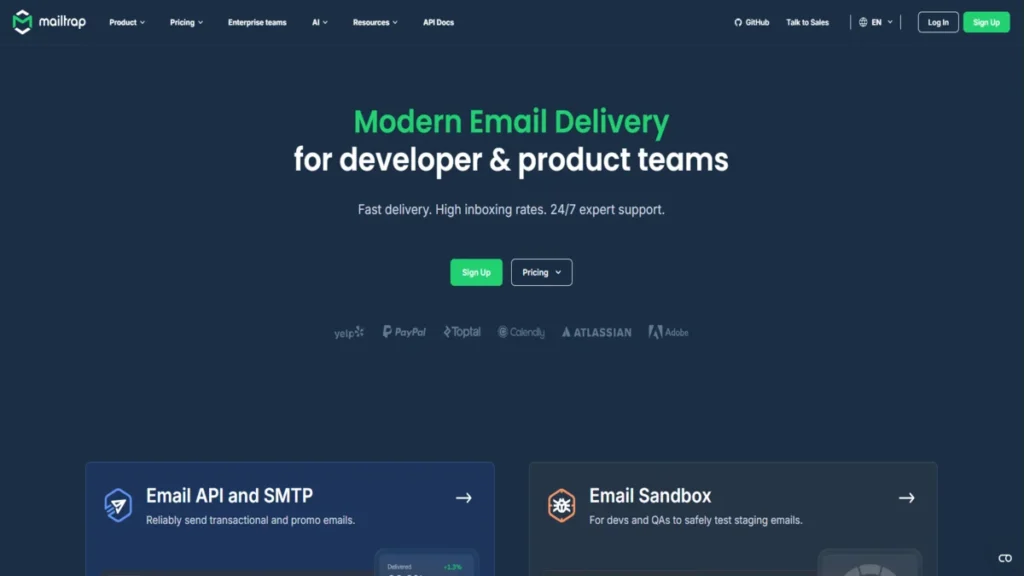
For developers and product teams seeking an email platform that is developer friendly, Mailtrap is one of the best options.
It has a RESTful email API for transactional email with comprehensive documentation. There are official SDKs for several popular programming languages, such as Node.js, Ruby, PHP, Python, Elixir, .NET, and Java.
Mailtrap also offers email testing and deliverability tools. This is helpful for teams that want to test messages as they’re developing them, but not sending them to actual recipients.
Mailtrap Pros
- Developer friendly REST API
- Robust email testing solutions
- Offers support for several programming languages
- Transactional email infrastructure
- Deliverability monitoring
- Free plan available
Mailtrap Cons
- There are some advanced features that require paid plans.
- It is not the best thing about it, however, that it verifies emails.
- There are fewer templates to choose from than other competitors.
Mailtrap is suitable when development, testing, and sending transactional e-mail is a priority.
2. Brevo
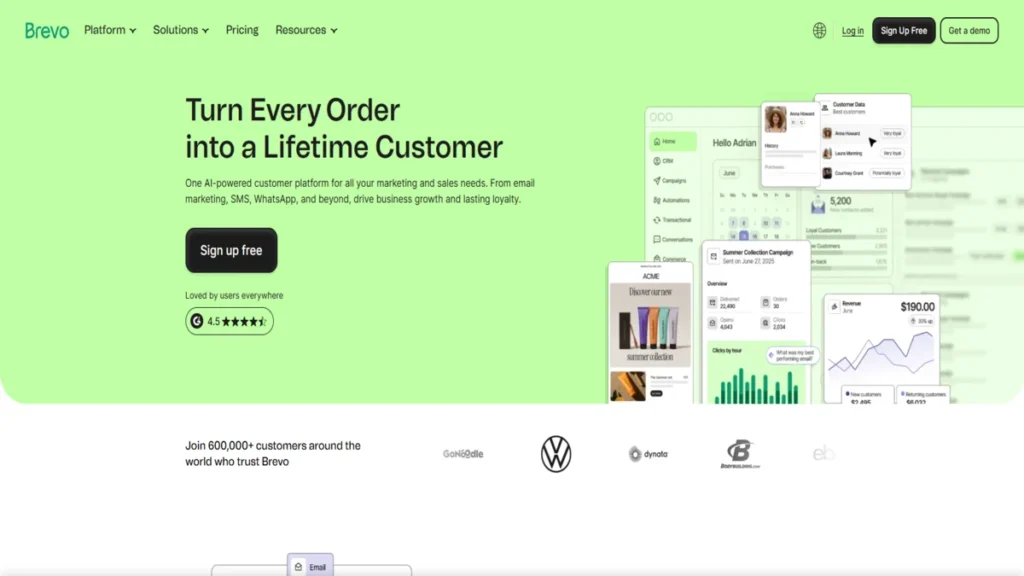
Brevo is a widely-used all-in-one communication tool that includes email marketing, transactional email, automation, and customer management capabilities.
It has an API that can be utilized to send transactional messages as well as manage marketing campaigns. Developers can use libraries for Node.js, PHP, Python, TypeScript, Java, C, Go, and Ruby.
Brevo is especially appealing to companies that wish to add email API capabilities to their marketing automation.
Brevo Pros
- Transactional and marketing emails are supported
- REST API
- Marketing automation
- Drag-and-drop email editor
- Multiple programming libraries
- Generous free plan
Brevo Cons
- The advanced features are only available on paid plans
- The options for support differ per plan
For companies looking for developer tools and marketing capabilities, Brevo is one of the top email API options available.
3. SMTP.com
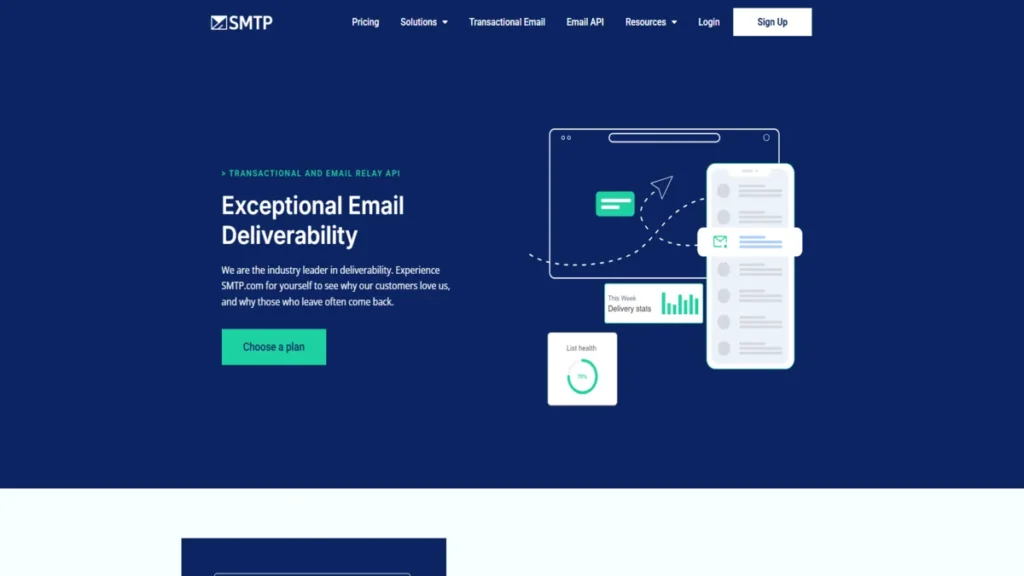
SMTP.com specializes in delivering emails and sending large volumes of emails.
The platform offers cloud-based infrastructure for companies that require sending out huge volumes of email. It has an API that can be used in applications and other platforms.
Another area that SMTP.com prioritizes is sender reputation and deliverability, which makes it ideal for organizations where email deliverability is a key concern.
SMTP.com Pros
- Specially engineered for high volume sending.
- Strong delivery infrastructure
- Email validation tools
- Detailed documentation
- The ability to send large volumes of data
- Customer support options
SMTP.com Cons
- A higher starting volume than some competitors.
- No large-scale library of first-party code.
- Email creation tools are limited
SMTP.com is more appropriate for larger projects requiring a lot of sending than for very small projects.
4. SMTP2GO
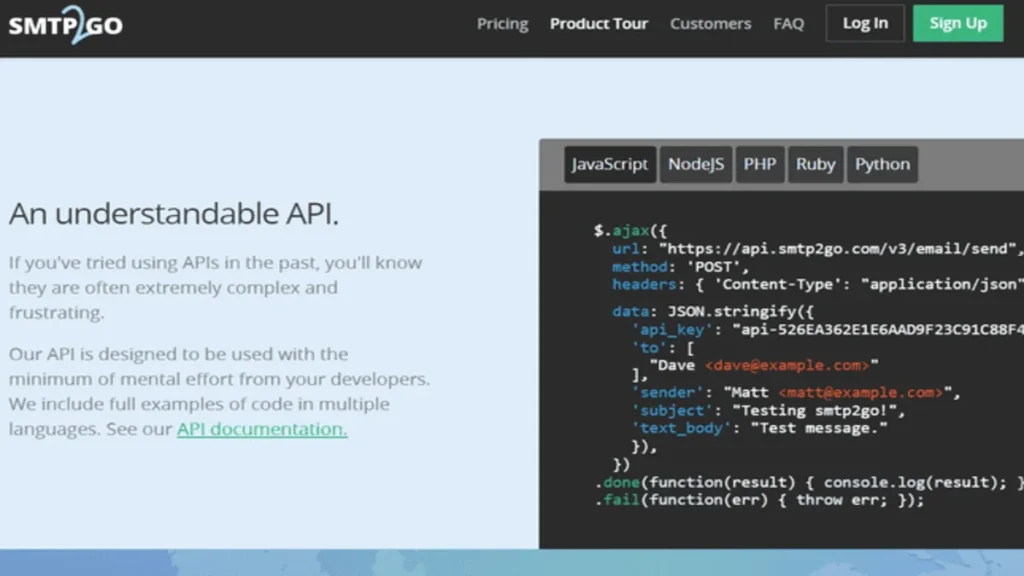
SMTP2GO is an SMTP and API based email delivery service that is focused on reliability.
It has infrastructure spread out in several places, which assists companies send e-mail to recipients globally. The developers can also get detailed reporting of sent messages.
A handy feature is inbox testing, which lets developers know how messages can look in various email clients.
SMTP2GO Pros
- Reliable global infrastructure
- Developer-friendly API
- Detailed reporting
- Inbox testing
- 24/7 support
- Free plan
SMTP2GO Cons
- The cost per email is more expensive than some competitors
- Less email creation options
For developers who value delivery reliability and monitoring, SMTP2GO is a good option.
5. MailerSend
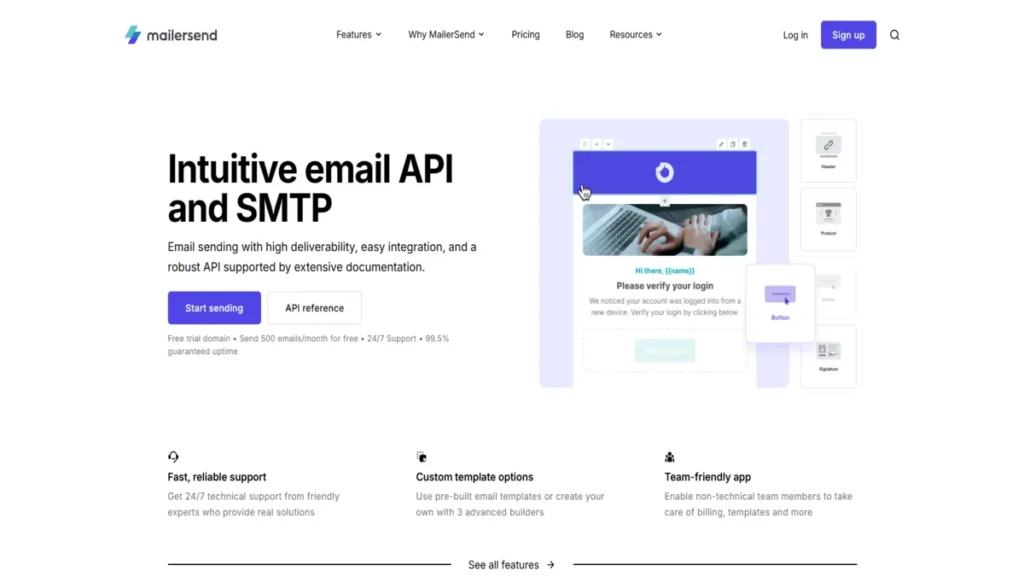
MailerSend is a transactional email service for small to medium businesses and developers.
It has an API that enables bulk sending, personalization, attachments and inbound email routing. It also offers SDKs and libraries for some of the widely used languages such as PHP, Node.js, Python, Ruby, Java, Golang, and Laravel.
MailerSend has several options for creating email templates, such as drag and drop and HTML editing.
MailerSend Pros
- Affordable starting price
- Developer-focused API
- Laravel support
- Email verification tools
- Multiple template editors
- Free plan
MailerSend Cons
- There is limited phone support.
- There is some advanced functionality which needs paid plans.
MailerSend is especially interesting to developers of PHP and Laravel applications.
6. Mailgun
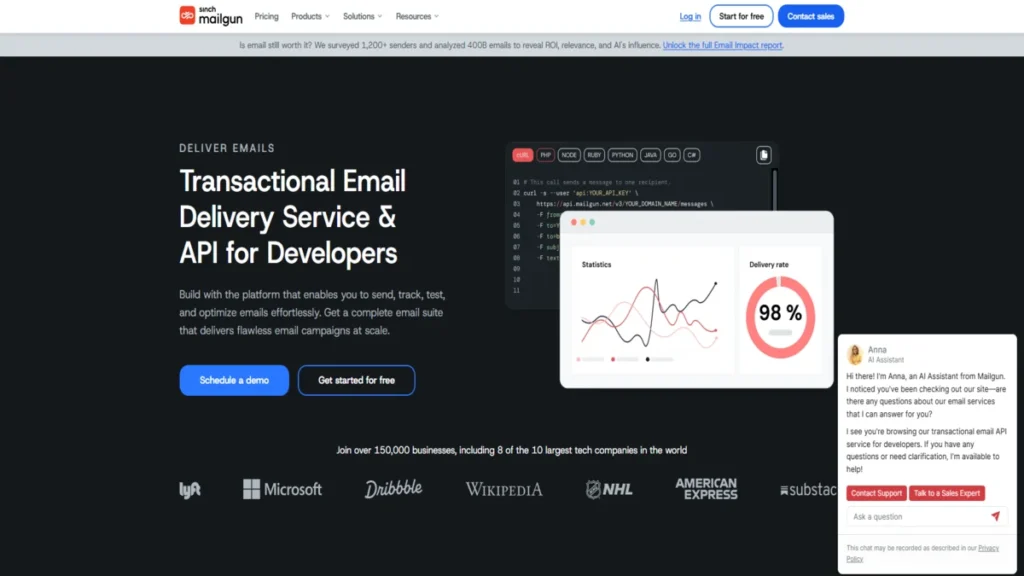
Mailgun has always been known for its developer-friendly email delivery.
It offers APIs for sending, tracking, templates, analytics and email validation. It also has an event system that developers can use to track the actions of individual messages.
Mailgun offers a wide range of programming languages and a comprehensive API documentation.
Its deliverability tools can also assist teams keep track of sender reputation, validate addresses, and test inbox placement.
Mailgun Pros
- Excellent developer documentation
- Several libraries of programming languages.
- Email validation
- Advanced analytics
- Inbox placement testing
- Scalable infrastructure
Mailgun Cons
- Advanced features may be costly
- There are some deliverability tools that need extra payment
Mailgun is a good choice for developers who need a comprehensive feature-rich email API with lots of technical controls.
7. Postmark
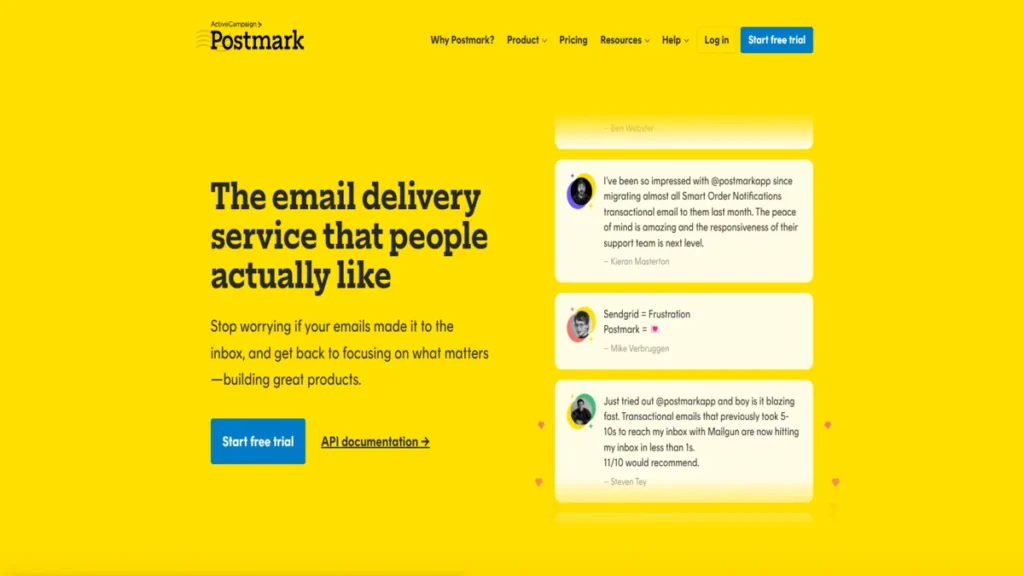
Postmark is a company that specializes in delivering emails reliably.
It’s especially ideal for sending messages like password resets, account verification emails, receipts, and notifications.
Postmark offers a RESTful API, developer libraries, templates, tracking, and detailed delivery info.
It also sorts transactional and broadcast email streams, allowing businesses to safeguard critical transactional messages from issues that may arise with marketing campaigns.
Postmark Pros
- Quick email delivery of transactions.
- Excellent API documentation
- Developer libraries
- Email templates
- Detailed delivery tracking
- Split up transactional and broadcast streams.
Postmark Cons
- Less focused on e-mail marketing.
- Email verification is not provided
- Depending on the plan, support options are available
For applications that require reliable and fast delivery of transactions, Postmark is one of the best email API services.
8. SendGrid
SendGrid is one of the leading email delivery services with developer and marketer tools.
It has an API for email that gives access to infrastructure for mass emailing. APIs can be used by developers to send messages, create templates, manage contacts, and automate email workflows.
SendGrid offers libraries for PHP, Python, Node.js, Java, C, Go and Ruby.
SendGrid Pros
- Perfect for bulk email
- Strong developer ecosystem
- Marketing and transactional features
- Email templates
- Analytics and reporting
- Free plan
SendGrid Cons
- Advanced features may be costly.
- Certain support options are only available on higher plans.
For organizations that require a more mature platform for development and marketing teams, SendGrid may be a good option.
9. Elastic Email
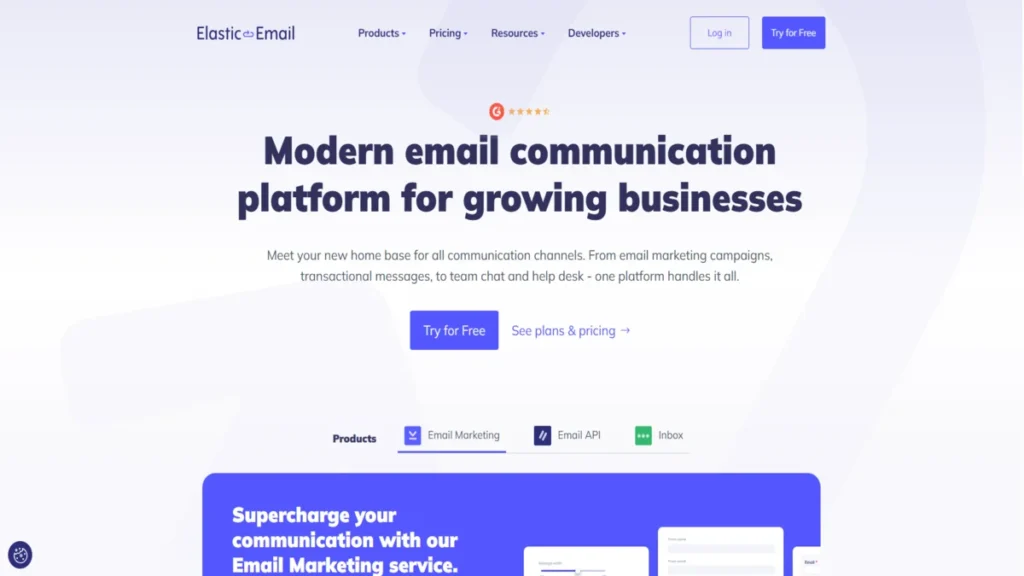
Elastic Email is a combination of email API with an affordable pricing model.
It has a platform that offers transactional email, marketing campaign, templates, email verification, and deliverability management.
It is compatible with various programming languages and offers integrations with popular website platforms and content management systems.
Elastic Email Pros
- Competitive pricing
- Email verification
- Developer API
- Multiple programming languages
- Marketing tools
- CMS and website integrations.
Elastic Email Cons
- Just a free trial.
- May need to learn how to use Interface
- The advanced features are more appropriate for the more advanced user.
If you have low email delivery costs as one of your key concerns, then you should consider Elastic Email.
10. SendPulse
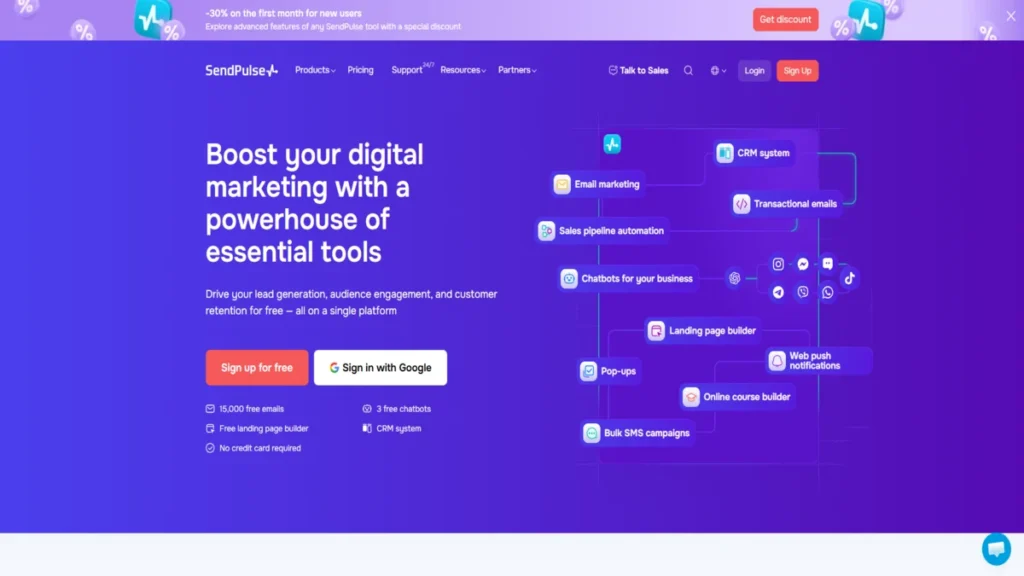
SendPulse is a full-fledged marketing platform that also offers an email API for transactional emails.
The API is available for PHP, Ruby, Python, Java, Node.js and C and allows developers to integrate email into their websites and applications.
Automation, marketing and customer communication tools are also available on the platform.
SendPulse Pros
- Free email allowance
- Transactional email API
- Marketing automation
- Multiple developer libraries
- On paid plans, you can choose dedicated IP options
- Flexible pricing
SendPulse Cons
- The number of advanced deliverability tools is less.
- More marketing-oriented than developer-only platforms
For businesses looking to integrate email API with other marketing capabilities, SendPulse is a suitable option.
11. Amazon SES
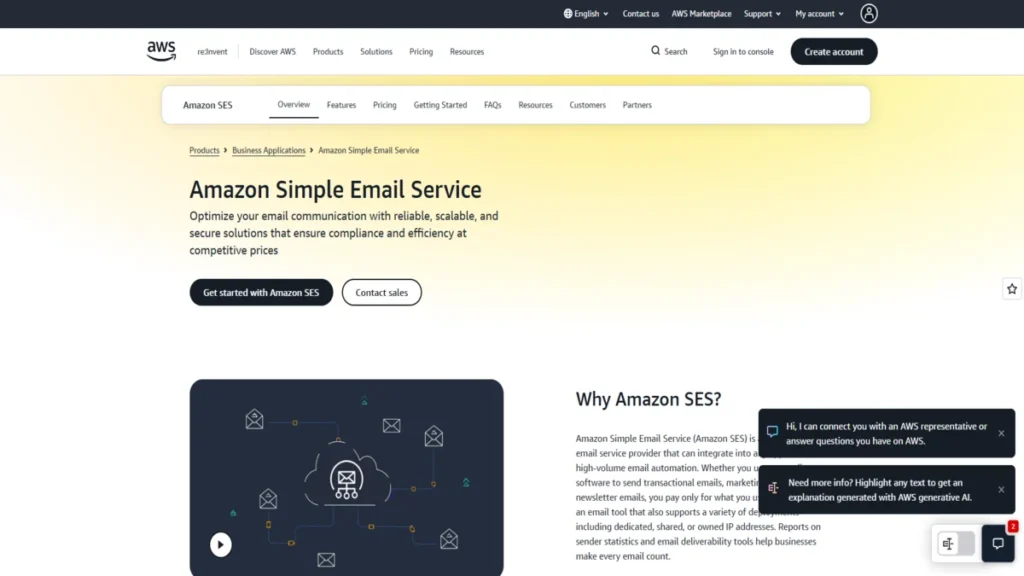
Amazon SES, also known as Amazon Simple Email Service, is one of the most scalable services in this list.
Since SES is a part of AWS, it can be especially appealing for developers who are already using AWS cloud services.
Amazon SES is pay-as-you-go, and can be very cost-effective at scale. The service is available via AWS SDKs and the AWS Command Line Interface.
There are also reputation, bounce, complaint and deliverability monitoring tools provided by SES.
Amazon SES Pros
- Very low pay-as-you-go pricing
- Highly scalable
- AWS integration
- Multiple SDKs
- Deliverability management tools
- Ideal for bulk outgoing mail.Good for large volume outgoing mail
Amazon SES Cons
- Setup may be more complex
- AWS has some jargon that can be confusing for beginners
- A customer support plan is crucial to AWS support.
For developers already using AWS, Amazon SES is one of the best options for email API.
Best Free Email API Services
A free plan might be very helpful if you’re creating a small application or testing an email workflow.
There are a number of popular choices:
| Service | Free Allowance | Best For |
|---|---|---|
| Brevo | 300 emails/day | Marketing and transactional email |
| Mailtrap | 4,000 emails/month | Developers and testing |
| SMTP2GO | 1,000 emails/month | Reliable delivery |
| SendPulse | 15,000 emails/month | Marketing and automation |
| MailerSend | 500 emails/month | Transactional email |
| Amazon SES | 3,000 emails/month | AWS developers |
Free limits may vary, so check before you select a provider.
Best Email API for Different Needs
No one provider is right for all projects.
Best Email API for Developers
For developers looking for testing, API and deliverability tools in a single platform, Mailtrap is a great choice.
Best Email API for Marketing
Brevo is a good option if you want to integrate with marketing automation and CRM applications and use email API.
Best Email API for Transactional Email
In particular, Postmark is ideal for transactional messages where speed and reliability are paramount.
Best Affordable Email API
MailerSend is a competitive API, templates and transactional email solution.
Best for High-Volume Sending
If cost and scalability are key considerations, Amazon SES cannot be overlooked, particularly for applications running on AWS.
Best for Deliverability Tools
For teams who require granular deliverability controls, Mailgun offers a wide range of analytics, validation and inbox-placement options.
How to Choose the Best Email API
First, determine the actual requirements of your application.
If you only require password reset and account verification emails, you likely don’t need to have a full marketing platform.
For ecommerce business owners, you might require transactional messages, automation, templates, analytics, and customer segmentation.
Reliability, webhooks, delivery tracking and developer documentation could be more critical for a SaaS app than marketing features.
Another thing you should consider is the amount of emails you are sending per month. A cheap-looking provider at 5,000 emails can cost a lot more at 500,000 emails.
Lastly, test the API before committing! An adequate free tier or trial can help you assess integration, documentation, delivery speed, reporting, and support.
Conclusion
There is no single feature that makes an email API the best, it’s all about the project.
For developers and teams who prioritize testing and deliverability, Mailtrap is a great option. Brevo is appealing for companies that wish to have email API capabilities in addition to marketing and automation. Mailgun offers a lot of developer and deliverability tools, and Postmark is particularly robust for transactional emails.
Both MailerSend and SMTP2GO have some developer-friendly features and are cost-effective solutions, while SMTP2GO has a strong emphasis on reliability and delivery tracking. If you’re looking for a more mature platform at scale, SendGrid is the best option, and if you’re looking for competitive pricing, Elastic Email is the way to go.
Amazon SES is a great option for AWS users due to its pay-as-you-go pricing and seamless integration with AWS.
When selecting your provider, take into account pricing, monthly volume, API documentation, programming language support, deliverability features, analytics, templates, integrations, and customer support.
Your email API should send your messages, but it should also be the right one. It should provide your application with a solid basis for dealing with email as your business expands.
FAQ
What is the best email API in 2026?
The best email API depends on your needs. Mailtrap, Brevo, Mailgun, Postmark, and Amazon SES are among the top options for different use cases.
What is an email API used for?
An email API allows websites and applications to automatically send emails such as password resets, order confirmations, account verification messages, notifications, and marketing emails.
Which is the best free email API?
Brevo, Mailtrap, SMTP2GO, MailerSend, SendPulse, and Amazon SES offer free plans. The right option depends on your required sending volume and features.
Which email API is best for transactional emails?
Postmark is a strong choice for transactional emails because it focuses on fast and reliable delivery. Mailgun and Mailtrap are also popular alternatives.
How do I choose the best email API?
Compare pricing, email limits, API documentation, programming language support, deliverability, analytics, integrations, scalability, and customer support before making your choice.


