

In the last 13 years, I have been using almost all the email marketing tools that are available in the market. My career started at an email marketing agency, where I worked for 8 years assisting businesses of all sizes with creating and optimizing their email marketing. Following that, I moved into consulting, advising more than 2,000 brands and senders on which software was best for them.
This is a long time of experience and I have discovered what is important and what is just fluff in email marketing software. We have tested over 30 email marketing platforms on this site, personally, and have tested all the features, analyzed pricing and evaluated deliverability rates.
We want to share our insights to save you time and help you make an informed decision. If you’re a newbie seeking a basic answer or an advanced marketer wanting to explore advanced automation, this guide will aid you in choosing the best email marketing platform for your business.
If you need more help, please don’t hesitate to contact us – we are always here to help.
What Makes a Great Email Marketing Platform?
Before we get to the individual reviews, let’s first discuss what I consider to be the essentials of an email marketing service. As I have been through the various platforms over the years, I’ve come up with a list of features that make the top platforms stand out from the rest.
Drag-and-Drop Email Editor
All email marketing platforms have some sort of email builder, but not all are the same. The best ones allow you to build professional emails with ease without any coding. I always check the ease of use of the editor, the number of pre-designed templates, and if it is possible to design something to fit your brand.
User-Friendly Automation
Modern email marketing is all about automation. The platform should be easy to use, whether you’re looking to send a simple welcome email or create more complex customer journeys with multiple triggers and conditions. I’m searching for a visual workflow builder that’s easy to use, even by a novice.
Landing Pages and Forms
Your email list is your most valuable asset. The best email marketing software has inbuilt tools to expand your list, including sign up forms, pop-ups, and landing pages. These should be simple to make and modify without having to involve a developer.
Personalization and Segmentation
Emails that are generic are no longer sufficient. The best platforms enable you to divide your audience by behaviour, interests and demographics. This allows you to send highly targeted and personalized messages that will lead to improved engagement and conversions.
Flexible Pricing
Cost is always a consideration. The best platform will have a pricing model that fits your company. It’s always a nice touch to have a generous free plan or a full-featured trial, so you can try the software before you commit.
Strong Deliverability Rates
If your emails get into the spam folder, then they are useless. The platform’s sending infrastructure and list hygiene practices are crucial for achieving high deliverability. When I check out each site I review, I always check the deliverability reputation.
The 16 Best Email Marketing Platforms for 2026
1. MailerLite – Best for Beginners

MailerLite is among the most cost-effective and easy-to-use email marketing solutions on the market today. It’s simple, but it packs in the essentials, making it a great option for small businesses, bloggers and anyone new to email marketing.
The user interface is clean and intuitive, making it easy to navigate. One of the most user-friendly email editors I’ve encountered, with more than 90 pre-designed templates to jumpstart your process. MailerLite even has forms, landing pages, and even a basic website builder.
I really like MailerLite’s automation features. It’s not as sophisticated as some of its competitors, but it has everything a small to medium-sized business could want – welcome emails, abandoned cart sequences, and audience segmentation are all simple to set up.
The free plan is generous, allowing up to 250 subscribers and 2,500 emails per month. The basic paid plans begin at only $12/month for 5,000 emails and 3 users.
Pros: Limited plans, a lack of advanced features, and the user interface could be improved.
Cons:Interface only available in three languages, automation less advanced than enterprise solutions.
2. Brevo – Best Free Plan

Brevo (formerly Sendinblue) is a robust email marketing and CRM solution for small businesses, ecommerce brands and marketers. It is more than just an email marketing solution, it has SMS marketing, WhatsApp messaging, and transactional email features.
Campaigns are easy to make in Brevo. The drag and drop editor is easy to use, but the template library is relatively small, with only 40+ templates. The platform’s strength, however, lies in its automation features, including website tracking, 12 pre-built workflows for lead nurturing, abandoned carts, and personalized follow-ups.
Brevo’s best feature is its free plan, which is quite generous. You can send up to 300 emails a day and have up to 100,000 contacts – all for free. This is an outstanding option for companies with many contacts and a small budget.
The paid plans begin at only $8.08 per month for 5,000 emails and are very affordable.
Pros: Excellent free plan, low pricing, strong automation, multi-channel support.
Cons: Not many templates available.
3. ActiveCampaign – Best for Marketing Automation

ActiveCampaign is considered one of the top marketing automation tools on the market. It supports businesses of all sizes and can provide anything from simple email campaigns to complex automated workflows.
It is a very powerful platform, but very easy to use. All the drag and drop editors for email, landing pages, and forms are user-friendly. There are more than 240 email templates and 60+ landing page templates to choose from.
The one thing ActiveCampaign is really good at is automation. There are more than 900 workflow templates, so you can imagine that there’s really no marketing or sales process that you can’t automate. Triggers and conditions are fully customizable, you have full control. The integrated CRM and AI-powered predictive analytics further enhance targeting and lead management.
The price begins at $15 per month for 10,000 emails and 1,000 contacts, and offers a 14-day free trial.
Pros: Price, limited customization options, complex setup, lack of flexibility.
Cons:It may be difficult for new users to get the hang of it.
4. Beehiiv – Best for Newsletters and Monetization

Beehiiv is a platform that focuses on how to monetize newsletters for creators and businesses. It is a dedicated platform to create, develop and monetize email publications.
The newsletter editor is easy to use and user-friendly, and features AI-powered tools for editing and enhancing text. Beehiiv has some special audience growth tools, such as Magic Link subscriptions, referral marketing, and cross-promotion.
They can monetize by offering paid subscriptions, affiliate links and an ad network. For content creators who want to monetize their audience, Beehiiv is a great option.
The paid plans begin at $43 per month and include unlimited emails and 100,000 subscribers. There’s a free plan that lets you use it with up to 2,500 subscribers.
Pros: AI writing tools, advanced growth features, multiple monetization options.
Cons: Costlier than some other competitors.
5. Moosend – Best for Small Businesses

Moosend is one of the most affordable email marketing platforms without compromising on features. It’s an outstanding value for money and even the cheapest plan includes advanced automation and personalization features.
The user interface is attractive and easy to use. All the drag and drop editors are uniform and intuitive. The automation is surprisingly advanced with more than 25 triggers and web tracking.
Moosend’s pricing is simple: a single plan that offers everything, and it’s based on the number of contacts. It’s very affordable, beginning at only $7 per month for 500 contacts.
Pros: Low cost, advanced automation, web tracking, unlimited emails.
Cons: No free plan, only a 30-day trial.
6. HubSpot – Best All-in-One Platform

HubSpot is a large player in the CRM market that provides marketing, sales, and service tools that are integrated. It has a Marketing Hub that provides all the tools you need for email marketing, automation, landing pages, forms, and analytics.
The key to HubSpot’s success is its flexibility. It offers a complimentary CRM and fundamental marketing features for small businesses, and customization choices for enterprises to tailor their own platform.
HubSpot’s email editor is powerful and easy to use. The platform has powerful automation features and can integrate with more than 1,500 third-party applications.
Paid plans begin at $20/month for 1,000 contacts and 5,000 emails. Basic marketing tools, 100 contacts and 2,000 emails are provided with the free plan.
Pros: All-in-one CRM, powerful automation, generous free plan, extensive integrations.
Cons: Prices rise steeply beyond basic plans.
7. Mailjet – Best for Newsletters and Email API

Mailjet is an all-in-one solution that integrates email marketing and transactional email sending. It’s perfect for medium-sized businesses that require newsletter and API features.
Unlike other pricing models that charge per contact, Mailjet’s volume pricing is an affordable option for businesses with large lists. It features drag-and-drop editor, templates, segmentation, A/B testing, and automation.
The automation builder has been enhanced with conditional logic for more advanced automation workflows. Developers will love the SMTP and email API integration.
The paid plans begin at $9 a month, and the free plan includes 1,000 contacts and 6,000 emails per month.
Pros: Unlimited contacts on paid plans, built-in deliverability tools, real-time collaboration.
Cons: Automation templates could be more extensive.
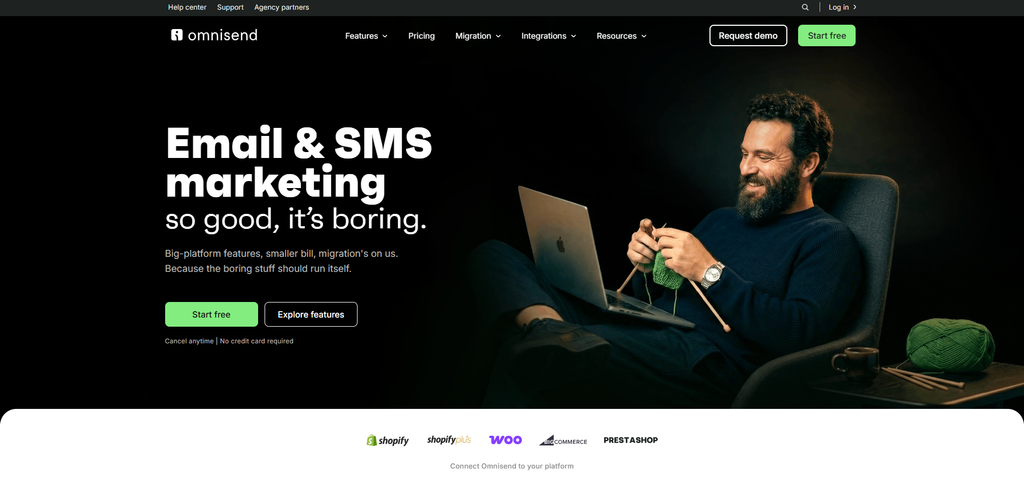
8. Omnisend – Best for Ecommerce

Omnisend is an ecommerce marketing platform designed specifically for ecommerce stores. It is optimized for sales via email, SMS and push notifications.
It has more than 350 e-mail templates that are designed for product promotion. It’s automation builder is very user friendly and has pre-made workflows for abandoned cart, welcome series, and order follow-up.
Omnisend segments and personalizes your messages using the data from your web store. The Customer Lifecycle Map feature is especially useful for lead nurturing across the various stages of the lifecycle.
The price begins at $16/month for 500 contacts and 6,000 emails. There is a free plan available for 250 contacts and 500 emails.
Pros: Conversion-focused tools, seamless ecommerce integrations, advanced segmentation.
Cons: Lacks a product page builder.
9. Bloomreach – Best for Advanced Personalization

Bloomreach is an enterprise level personalization and marketing automation platform. It’s intended for mid-market and large ecommerce brands that have more advanced requirements.
The platform leverages customer information to provide one-to-one experiences via email, SMS, web and mobile apps. It uses Loomi AI to enhance product recommendations, predictive targeting, content creation, and analytics.
Bloomreach is robust and complicated, and needs vast amounts of data and technical resources. Not appropriate for small businesses.
Custom and annual pricing, usually beginning at the six figure mark.
Pros: Excellent personalization, advanced AI tools, multi-channel capabilities.
Cons: Expensive, steep learning curve.
10. AWeber – Best for Email Design

One of the oldest email marketing platforms, AWeber has more than a million customers. Still in use for its simplicity and design.
The drag-and-drop editor is intuitive, and the template library includes over 600 designs. A standout feature is Smart Designer, which automatically generates branded templates from your website URL. AWeber also integrates with Canva for in-editor graphic design.
Automation features are basic, making AWeber suitable for simple email campaigns but not complex workflows.
Pricing starts at $12.50 per month for 500 contacts and unlimited emails. A free plan is available for 500 subscribers and 3,000 emails monthly.
Pros: Beautiful templates, Canva integration, user-friendly interface.
Cons: Basic automation features.
11. Kit – Best for Creators and Subscriber Growth

Kit (formerly ConvertKit) is designed for creators – bloggers, podcasters, influencers, and authors. It offers tools for audience growth, email campaigns, and monetization.
The email and landing page editors are modern and easy to use. Kit’s Creator Network enables cross-promotion with other creators, while the Sponsor Network helps find brand partnerships.
Automation is advanced, with visual workflow builders and conditional logic. Segmentation and tagging are also robust.
Pricing starts at $39 per month for 1,000 subscribers and unlimited emails. A free plan is available for up to 10,000 subscribers but limits automations.
Pros: Creator-focused, advanced automation, excellent growth tools.
Cons: Lacks some CRM features.
12. Mailchimp

Mailchimp is perhaps the most well-known email marketing platform. Many businesses start with it simply because of its brand recognition.
However, Mailchimp is not a platform I generally recommend. It has become expensive, with unfair pricing where you pay double for inactive contacts. The free plan is limited, and the interface is less intuitive than competitors like MailerLite or Brevo.
There are many better alternatives available at lower prices.
Pros: Well-known brand, extensive integrations.
Cons: Expensive, unfair pricing, less intuitive interface.
13. Campaigner

Campaigner is designed for high-volume email marketing. It offers advanced automation, segmentation, and personalization tools suitable for larger marketing teams.
The platform includes an email API for bulk sending, reputation management tools, and dynamic content personalization. Automation workflows support both email and SMS in the same sequences.
Pricing is higher than many competitors, starting at $14 per month for 1,000 contacts and 6,000 emails. A 30-day free trial is available.
Pros: Advanced automation, reputation management, high deliverability.
Cons: More expensive than rivals.
14. GetResponse

GetResponse has evolved into a complete online marketing platform. It remains affordable and user-friendly, making it a solid choice for start-ups and small businesses.
The drag-and-drop editor comes with 120+ customizable templates. Automation tools include conditional workflows and web tracking. The funnel builder helps convert subscribers into customers.
Pricing starts at $19 per month for 1,000 contacts and unlimited emails. A free plan includes 2,500 emails and 500 contacts.
Pros: Scalable platform, affordable, sales funnels.
Cons: Some templates look outdated.
15. Constant Contact

Constant Contact is one of the oldest email marketing tools. It includes automation, lead generation, and event promotion features.
The drag-and-drop editor is intuitive, with 300+ templates and an AI writing assistant. Automation is basic – suitable for simple sequences like welcome emails but not complex workflows.
Social media and event marketing tools are strengths. Pricing starts at $12 per month for 500 contacts and 5,000 emails.
Pros: Event marketing tools, AI writing, social media integration.
Cons: Limited automation.
16. Benchmark Email

Benchmark Email is a well-established platform for SMEs. It is user-friendly and offers good value for money.
The drag-and-drop editor is quick to learn, with 200+ responsive templates in multiple languages. Automation is straightforward, with a visual workflow builder and 11 pre-built templates.
Pricing starts at $13 per month for 500 contacts and 7,500 emails. A free plan includes 500 contacts and 3,500 emails.
Pros: Beginner-friendly, multilingual templates, visual automation.
Cons: Less design flexibility than competitors.
Best Email Marketing Platforms by Industry
Best for Small Businesses
- MailerLite – Best overall value.
- Brevo – Generous free plan with multi-channel support.
- Moosend – Cheapest option with advanced automation.
Best for Ecommerce
- ActiveCampaign – Powerful automation and CRM.
- Omnisend – Dedicated ecommerce tools.
- Bloomreach – Advanced personalization for enterprise brands.
Best for Newsletters
- Beehiiv – Monetization and growth tools.
- MailerLite – Simple and affordable.
- Kit – Creator-focused features.
Best Free Plans
- Brevo – 100,000 contacts, 300 emails daily.
- MailerLite – 250 subscribers, 2,500 emails monthly.
- Mailjet – 1,000 contacts, 6,000 emails monthly.
Best for Affiliate Marketing
- GetResponse – Explicitly supports affiliate marketing.
- Moosend – Affordable with strong automation.
Final Thoughts
Choosing the best email marketing platform is a personal decision based on your business size, budget, and specific needs. After reviewing dozens of platforms, here are my top recommendations:
ActiveCampaign remains my favourite all-around solution. It balances user-friendly design with powerful automation, making it suitable for businesses of all sizes.
For budget-conscious businesses, MailerLite, Brevo, and Moosend are all excellent choices. Each offers great features at affordable prices.
If you need help making a decision, feel free to reach out. I am always happy to provide guidance based on your specific situation.
FAQ
Which platform is best for email marketing?
The answer depends on your needs. ActiveCampaign is best for automation. MailerLite is best for beginners. Brevo is best for free plans. Omnisend is best for ecommerce.
What is the most cost-effective email marketing platform?
Moosend offers the lowest starting price at $7 per month. Brevo and MailerLite also offer excellent value.
Is email marketing still worth it?
Yes, email marketing continues to deliver one of the highest ROI of any digital marketing channel.
Is Mailchimp a good email marketing service?
Mailchimp is well-known but has become expensive and less intuitive than alternatives like MailerLite or Brevo.


