Two-thirds of breached organizations in IBM’s 2026 Cost of a Data Breach research had no governance in place to manage AI or detect shadow AI, and only 19% said their AI governance and security teams coordinate. The gap is rarely a missing policy. It is a missing AI governance operating model: a clear answer to who approves an AI system, who can stop it, and how fast those decisions are made. This guide gives you that answer, with verified 2026 regulatory dates, a tier-based RACI matrix, a steering committee charter and a 90-day rollout plan.
Key Takeaways
- An AI governance operating model assigns decision rights (approve, monitor, suspend, retire) to named roles. Policies and frameworks describe what good looks like; the AI governance operating model decides who acts.
- New to AI governance? Start with a small central hub, then move to a federated hub-and-spoke AI governance operating model once low-risk requests dominate the queue. Never decentralize high-risk approvals.
- Give every decision exactly one accountable owner, and separate the right to approve from the right to stop.
- Tier every use case by risk, so minimal-risk requests clear in a day and only high-risk systems reach the AI steering committee.
- EU AI Act dates changed in 2026: Annex III high-risk obligations now apply from 2 December 2027, while prohibited practices, AI literacy and transparency duties are already live.
What Is an AI Governance Operating Model?
An AI governance operating model is the organizational design that turns AI policy into day-to-day decisions. It defines who owns each AI system, who may approve or suspend it, how risk is tiered, which forums review what, and how evidence reaches leadership. Put simply, it is the “who decides, how fast, and on what evidence” layer of enterprise AI governance. A working AI governance operating model has five components: roles, forums, risk tiers, workflows and metrics.
Teams often confuse it with neighboring documents. This table separates the three layers.
| Layer | Question it answers | Typical artifact | Usual owner |
|---|---|---|---|
| AI policy | What is allowed? | Acceptable-use policy, prohibited uses | Legal, compliance |
| AI governance framework | What must be true for AI to be trustworthy? | Principles, controls, risk taxonomy | AI Governance Lead |
| AI governance operating model | Who decides, how fast, on what evidence? | Roles, RACI, committee charter, intake workflow, SLAs | Executive sponsor and steering committee |
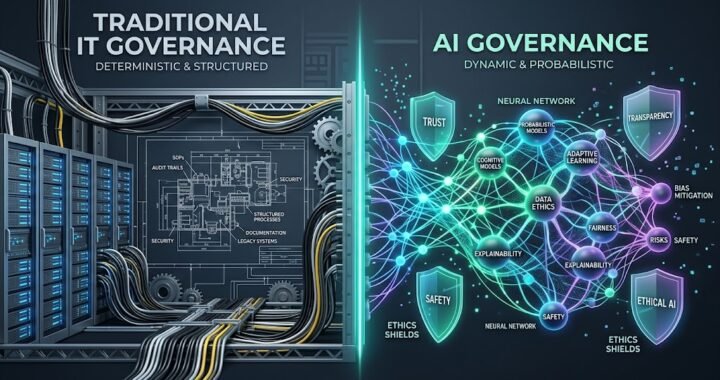
For the control-level view, read our AI governance framework guide. To see why AI needs different oversight than traditional IT, read AI governance vs IT governance.
Why an AI Governance Operating Model Matters: What the 2026 Data Shows
Two sources frame the business case.
IBM Cost of a Data Breach Report 2026 (Ponemon Institute research across 602 breached organizations, March 2025 to February 2026):
- The global average breach cost reached $4.99 million, and breaches in which attackers used AI averaged about $6 million, according to IBM’s release.
- 68% of breached organizations lacked governance to manage AI or detect unsanctioned use, up from 63% a year earlier, per ComplexDiscovery’s analysis.
- Shadow AI incidents rose from 20% to 43%, and those breaches averaged $5.39 million versus $4.63 million a year before.
- Only 19% reported coordination between AI governance and security teams, and 92% of organizations with an AI-related breach lacked proper AI access controls.
McKinsey Global Survey on AI (March 2025, 1,491 participants): 28% of respondents at AI-using organizations said their CEO oversees AI governance, and 17% said the board does. CEO oversight was one of the elements most correlated with higher self-reported EBIT impact from generative AI, especially at larger companies.
Read these numbers with care. IBM sells security products, and McKinsey’s results are self-reported and correlational. Still, both point the same way: cost and value follow ownership and coordination, not the length of the policy library. A well-designed AI governance operating model is how that ownership gets assigned.
EU AI Act Timeline 2026: What Your AI Governance Operating Model Must Absorb
The EU AI Act (Regulation (EU) 2024/1689) remains the main hard-law driver for global enterprises, and it changed in July 2026. The Digital Omnibus on AI (Regulation (EU) 2026/1744) entered into force on 27 July 2026, postponing the high-risk rules while leaving other duties in place, as Orrick’s summary of the final text explains.
| Date | What applies | What it means for your AI governance operating model |
|---|---|---|
| 2 Feb 2025 | Prohibited practices (Art. 5) and AI literacy (Art. 4) | Add a “prohibited” stop-gate at intake and name an owner for AI literacy |
| 2 Aug 2025 | General-purpose AI model obligations | Run vendor due diligence on foundation-model suppliers |
| 2 Aug 2026 | Transparency duties (Art. 50) for new systems | Route chatbots and generated content to Tier 2 review |
| 2 Dec 2026 | Art. 50(2) marking for older generative systems; two new Art. 5 bans (non-consensual intimate imagery, child sexual abuse material) | Update your prohibited-use list and legacy inventory |
| 2 Dec 2027 | Annex III high-risk systems (employment, credit, education, biometrics), moved from 2 Aug 2026 | Have the Tier 3 review path ready and tested |
| 2 Aug 2028 | Annex I high-risk AI embedded in regulated products | Bring product-safety teams into the committee |
Two practical notes. First, the Omnibus softened Article 4: organizations must now take measures to support AI literacy rather than guarantee a set level for each person. Second, the European Commission still frames the Act around four risk levels (unacceptable, high, limited, minimal), so your internal tiers should map to them. Dates were checked on 18 October 2026; confirm how they apply to you with counsel.
Three AI Governance Operating Model Types Compared
Most enterprises choose among three archetypes, and the right AI governance operating model depends on regulation, scale and maturity.
| Centralized | Decentralized | Federated (hub-and-spoke) | |
|---|---|---|---|
| Who decides | Central office approves everything | Each business unit decides | Hub sets guardrails; stewards approve low-risk work; committee decides high-risk work |
| Speed | Slows as volume grows | Fastest | Fast for Tier 1–2, deliberate for Tier 3 |
| Consistency | High | Low | High when tiers and tooling are shared |
| Main risk | Bottleneck and shadow AI | Fragmented risk, duplicate vendors | Uneven steward skill across units |
| Best when | New programs, heavy regulation | Few, low-risk use cases | Many use cases across many units |
Which AI governance operating model fits you? A two-axis scorecard
Score each factor 0 to 2. This is an editorial heuristic created for this guide, not an industry standard.
| Axis | Factor | 0 | 1 | 2 |
|---|---|---|---|---|
| Control need | Regulatory exposure | Low | Sector rules apply | High-risk use cases or heavy regulation |
| Control need | Data sensitivity | Public data | Internal data | Personal or regulated data |
| Control need | Governance maturity | Established | Partial | None yet |
| Scale | Use cases in production | A few pilots | Several teams | Embedded across functions |
| Scale | Business-unit spread | One unit | A few units | Many units or countries |
Add the three control-need scores (maximum 6) and the two scale scores (maximum 4).
| Result | Recommended operating model |
|---|---|
| Control 4 or more, scale 2 or less | Centralized |
| Control 4 or more, scale 3 or more | Federated with a strong hub; stewards limited to Tier 1–2 |
| Control 3 or less, scale 3 or more | Federated with light guardrails |
| Control 3 or less, scale 2 or less | Lightweight decentralized: inventory, prohibited uses, incident contact |
Our default for newcomers adopting an AI governance operating model is to begin centralized, even if the hub is two people, and to delegate Tier 1 and 2 decisions to stewards once low-risk requests dominate the intake queue or SLAs start slipping. Keep Tier 3 central at every stage.
AI Governance Operating Model Roles and Responsibilities: Who Holds Which Decision Right
Titles matter less than decision rights. Each role below holds one clear right and one guardrail.
| Role | Core decision right | Typically filled by | Guardrail |
|---|---|---|---|
| Executive sponsor | Chairs the committee, sets AI risk appetite, breaks deadlocks | CDO, CTO, COO or CRO | Must fund and empower the governance function |
| AI steering committee | Approves Tier 3 use cases and policy exceptions; reviews incidents | Cross-functional senior leaders | Members recuse on their own systems |
| AI Governance Lead | Owns tiering method, registry, intake and emergency suspension | Dedicated lead in risk, compliance or data office | Needs delegated authority to pause systems |
| AI Steward | Approves Tier 2 within delegated scope | Senior practitioner in each function | Escalates anything above delegated tier |
| Business or product owner | Accountable for outcomes, monitoring and retirement | Business unit or product lead | Cannot self-approve Tier 3 |
| AI/ML lead | Builds, documents and tests; maintains model cards | Engineering or data science lead | Not the only validator of own work |
| Security (CISO) | Security testing, access control, containment | CISO organization | Coordinates with governance, not parallel to it |
| Privacy or DPO | Data protection assessments and lawful basis | DPO or privacy counsel | Preserve statutory independence |
| Legal and compliance | Regulatory classification, contracts, prohibited-use calls | General counsel, compliance | Confirms internal tiers against law |
| Internal audit | Independent assurance that the model works | Internal audit function | Reports to the board, not management |
Map these roles to the IIA’s Three Lines Model: business owners and AI/ML teams manage risk as the first line; governance, security, privacy and compliance provide oversight as the second; internal audit gives independent assurance to the governing body. Small organizations may blend lines, but audit independence should survive.
How to Build an AI Steering Committee
The AI steering committee is the governing forum of the AI governance operating model. Capture these elements in a one-page charter:
- Mandate: approve Tier 3 use cases, own risk appetite, grant policy exceptions, and review incidents and audit findings.
- Membership: executive sponsor (chair), CISO, privacy lead, legal and compliance, AI/ML leadership, two or three business leaders, and the AI Governance Lead as secretary. Internal audit observes to preserve independence.
- Quorum and voting: define a quorum (for example chair, legal, security and one business leader), decide by majority with the chair breaking ties, and document a right for legal or security to escalate decisions.
- Conflict of interest: business leaders do not vote on their own unit’s systems.
- Cadence: a monthly standing meeting plus an out-of-cycle session within 48 hours for severe incidents (a suggested starting point).
- Decision log: record every approval, rejection and exception with rationale, conditions and a review date.
- Reporting: a quarterly summary of the KPIs below to executive leadership or the board.
Not every request belongs in a meeting. Tier 1 and Tier 2 work should flow through intake and stewards so the committee spends its time on high-risk decisions.
AI Governance RACI Matrix by Risk Tier
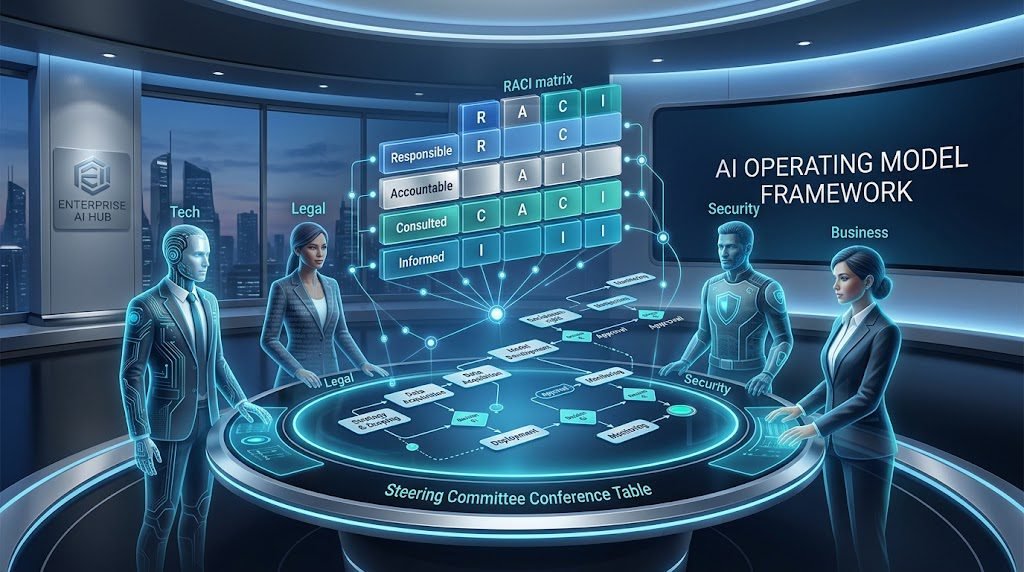
A RACI matrix answers one question for every task: who decides, who does the work, who must be asked first, and who is kept informed. This AI governance operating model RACI matrix changes those answers as risk rises: low-risk work stays with the business owner, while high-risk work goes to the steering committee.
How to read the table:
- Decides (A): one person or group makes the final call and owns the outcome.
- Does the work (R): the people who carry out the task.
- Must be asked first (C): those whose input is needed before the decision.
- Kept informed (I): those who are told the outcome but do not decide or do the work.
| Activity | Decides (A) | Does the work (R) | Must be asked first (C) | Kept informed (I) |
|---|---|---|---|---|
| Submit use case and triage form | Business or product owner | Business or product owner | AI/ML lead, AI Steward | AI Governance Lead |
| Assign risk tier | AI Governance Lead | AI Steward | Business owner, AI/ML lead, Security and privacy, Legal and compliance | Steering committee |
| Approve Tier 1 (minimal) | Business owner | Business owner | AI/ML lead | AI Steward, Security and privacy, AI Governance Lead |
| Approve Tier 2 (moderate) | AI Steward | Business owner, AI/ML lead | Security and privacy, Legal and compliance | AI Governance Lead |
| Approve Tier 3 (high) | Steering committee | Business owner, AI/ML lead, AI Governance Lead (prepares the case) | AI Steward, Security and privacy, Legal and compliance | None |
| Independent testing and validation | AI Governance Lead | AI/ML lead, Security and privacy | AI Steward, Legal and compliance | Business owner, Steering committee |
| Third-party AI due diligence | AI Governance Lead | Business owner, Security and privacy, Legal and compliance | AI/ML lead, AI Steward | Steering committee |
| Registry entry and model cards | AI Governance Lead | Business owner, AI/ML lead, AI Steward | None | Security and privacy, Legal and compliance, Steering committee |
| Production monitoring | Business owner | AI/ML lead, Security and privacy | Legal and compliance | AI Steward, AI Governance Lead |
| Emergency suspension (kill switch) | AI Governance Lead | AI/ML lead, Security and privacy | Business owner, Legal and compliance | AI Steward, Steering committee |
| Policy exceptions | Steering committee | AI Governance Lead | Business owner, AI Steward, Security and privacy, Legal and compliance | None |
| Decommissioning | Business owner | AI/ML lead | AI Governance Lead, Security and privacy, Legal and compliance | AI Steward, Steering committee |
| Periodic review and reporting | Steering committee | AI Governance Lead | Business owner, AI/ML lead, AI Steward, Security and privacy, Legal and compliance | None |
BO
Example: a CV-screening tool is Tier 3. The business owner, AI/ML lead and AI Governance Lead prepare the case, security and legal are asked first, and the steering committee decides.
Three design rules sit behind the table:
- One decider per row. Shared accountability becomes no accountability.
- Separate the right to approve from the right to stop. The AI Governance Lead, with the CISO as delegate, can suspend any system pending review, while only the committee approves Tier 3.
- No self-grading. The team that builds a system should not be the only team that signs off its testing.
Treat this as a starting template, not a legal allocation of liability. Adapt it to your authority structure, risk appetite and applicable law.
Risk-Tier Intake Workflow, Triage Questions and SLAs
Speed comes from sorting: a good AI governance operating model sends most requests down a fast lane. Ask these seven questions at intake:
- Does the system make or materially influence decisions about people (hiring, credit, pay, education, access to services)?
- Does it process personal, confidential or regulated data?
- Is it customer-facing, or does it generate content people could mistake for human or authentic?
- How much human oversight exists: approval before action, review after, or none?
- Is it built in-house, supplied by a vendor, or an embedded feature in a tool you already use?
- Can it take actions on its own (send, purchase, change records)?
- Could it fall under a prohibited practice or one of your own red lines?
Tier-up rules: a yes to question 1 sets Tier 3 as the minimum. A yes to question 7 stops the request for legal review (Tier 0). A yes to both questions 2 and 6 sets Tier 2 as the minimum. A yes to question 3 triggers a transparency check. Agentic systems that act autonomously should stay at Tier 2 or above until their action limits and oversight are proven.
| Tier | Maps to EU AI Act level | Typical examples | Approver | Suggested SLA |
|---|---|---|---|---|
| Tier 0, Prohibited | Unacceptable risk | Social scoring; tools generating non-consensual intimate imagery | Rejected; Legal records the decision | Immediate |
| Tier 1, Minimal | Minimal risk | Summarizing public reports; spell-check | Business owner, auto-approved with registry entry | Same day |
| Tier 2, Moderate | Often limited risk (transparency duties) | Customer chatbots, generative drafting, copilots over internal documents | AI Steward | 5 business days |
| Tier 3, High | High-risk (Annex III) or high-impact | Hiring screening, credit decisions, education scoring | Steering committee | Next monthly meeting (about 4 weeks at most), with an expedite path |
Internal tiers are not legal classifications; legal must confirm EU AI Act status. The SLAs are suggested starting points, not benchmarks, so calibrate them to your intake volume.
Crosswalk: NIST AI RMF, ISO/IEC 42001 and the EU AI Act
You do not need three parallel programs. One AI governance operating model can satisfy all three structures. The NIST AI Risk Management Framework organizes work into Govern, Map, Measure and Manage, and NIST also published a Generative AI Profile (NIST-AI-600-1) in July 2024. ISO/IEC 42001:2023 is the first AI management system standard.
| AI governance operating model component | NIST AI RMF | ISO/IEC 42001 | EU AI Act touchpoint |
|---|---|---|---|
| Steering committee, policy, roles | Govern | Leadership and planning | Art. 4 literacy; Art. 17 quality management (high-risk providers) |
| Intake and risk tiering | Map | Planning (risk and impact assessment) | Art. 5 prohibitions; Art. 6 and Annex III classification |
| Independent testing and validation | Measure | Performance evaluation | Art. 9 risk management; Art. 15 accuracy, robustness, cybersecurity |
| Monitoring, suspension, incidents | Manage | Operation and improvement | Art. 26 deployer duties incl. human oversight; Arts. 72–73 monitoring and incident reporting |
High-risk articles apply from the dates in the timeline above. NIST’s framework is voluntary, so use it as structure rather than as a compliance claim.
Metrics: How to Know Your AI Governance Operating Model Works
Track a small set monthly:
- Inventory coverage: share of known AI systems, including embedded vendor features, that sit in the registry.
- Time to decision: median days per tier against its SLA.
- Low-risk share: percentage of requests closed at Tier 1–2, which shows whether federation is working.
- Shadow AI: discoveries per quarter and days to onboard or remove each one.
- Overdue findings: open high-risk findings past their due date.
- Incident speed: time to suspend and time to notify after detection.
- Review currency: Tier 3 systems reviewed within their scheduled period.
- Literacy coverage: share of relevant staff who completed role-based AI training.
90-Day AI Governance Operating Model Implementation Roadmap
Days 1–30, discover and decide. Inventory AI use, including shadow AI. Name the executive sponsor and AI Governance Lead. Draft the prohibited-use list and publish an interim intake form.
Days 31–60, stand up. Charter the committee, approve tier definitions and the RACI, launch the registry, and run one Tier 3 review as a pilot. Agree the emergency suspension path with the CISO.
Days 61–90, scale and prove. Train stewards, publish SLAs and a KPI dashboard, run a tabletop AI incident exercise, deliver the first executive report, and schedule an internal audit review.
Seven Mistakes That Break an AI Governance Operating Model
- Business owners approving their own high-risk systems. Fix: committee approval for Tier 3 with recusal.
- No right to stop. Fix: a pre-delegated emergency suspension authority.
- Governance and security working separately. Only 19% of breached organizations reported coordination in IBM’s data. Fix: a shared intake and a standing security seat.
- Starting with policy instead of inventory. You cannot govern what you cannot see. Fix: discover shadow AI first.
- Everything goes to the committee. Fix: tiering, stewards and SLAs.
- Titles without decision rights. Fix: one accountable owner per row.
- One-time rollout. Fix: a review cadence, KPIs and annual audit.
AI Governance Operating Model FAQ
What is an AI governance operating model?
It is the structure of roles, forums, decision rights and workflows that turns AI policy into approvals, monitoring and shutdown decisions across the AI lifecycle.
Who should chair the AI steering committee?
An executive with budget and cross-functional authority, commonly the CDO, CTO, COO or CRO. Choose the person who can resolve disputes between business, security and legal.
How often should the committee meet?
Monthly is a common starting cadence, with an out-of-cycle session for severe incidents. Adjust to your Tier 3 volume.
Is a federated model better than a centralized one?
Not automatically. Centralized suits new or heavily regulated programs; federated suits many use cases across many units. Use the scorecard above, and keep Tier 3 central either way.
Does the EU AI Act require an AI steering committee?
No. The Act sets duties for providers and deployers but does not prescribe a committee. Deployers of high-risk systems must assign human oversight to people with the necessary competence and authority (Art. 26), and a clear AI governance operating model is how you evidence that.
Do small companies need an AI governance operating model?
Yes, in lightweight form: an AI inventory, a prohibited-use list, one named owner and an incident contact. Add tiers and a committee as use grows.
Conclusion: Make Decisions Visible
An effective AI governance operating model makes three things visible: who owns each AI system, who can approve or stop it, and how quickly the organization can act. Start this week with three moves: inventory your AI use, name a sponsor and an AI Governance Lead, and adopt the tier-based RACI above. Then assess your progress with our AI governance maturity model and revisit the model each quarter as regulation and your AI portfolio change. If you want the broader strategic case, read why AI transformation is a problem of governance.