Cold email in 2026 is not dead. It is divided. Generic mass blasts pull reply rates of 1 to 3 percent and burn sender reputations, while disciplined signal-based outreach reaches 8 to 12 percent and books meetings every week. The Instantly 2026 benchmark report, built on billions of cold email interactions, puts the platform-wide average reply rate at 3.43 percent, with the top quartile at 5.5 percent and the top 10 percent of senders clearing 10.7 percent. The gap between average and elite is not copywriting. It is list quality, deliverability discipline, and follow-up persistence. This guide explains the cold email 2026 playbook: the 30/30/50 rule, the buying signals that replace spray and pray, the authentication and warm-up stack that keeps mail in the inbox, and the human-reviewed personalization that survives AI detection. Email remains the channel where marketers reach decision makers directly, which is one reason why email marketing still wins against noisier channels.
One caveat before the numbers. The often-quoted 8.5 percent reply rate from the Backlinko and Pitchbox study measures link-building outreach from 2019, not B2B sales cold email, so treat it as a link-building figure rather than a sales benchmark. The 2026 figures below come from platform-level cold email data, which is the comparison that matters for a B2B cold email program.
Cold Email 2026 Benchmarks: What Good Looks Like
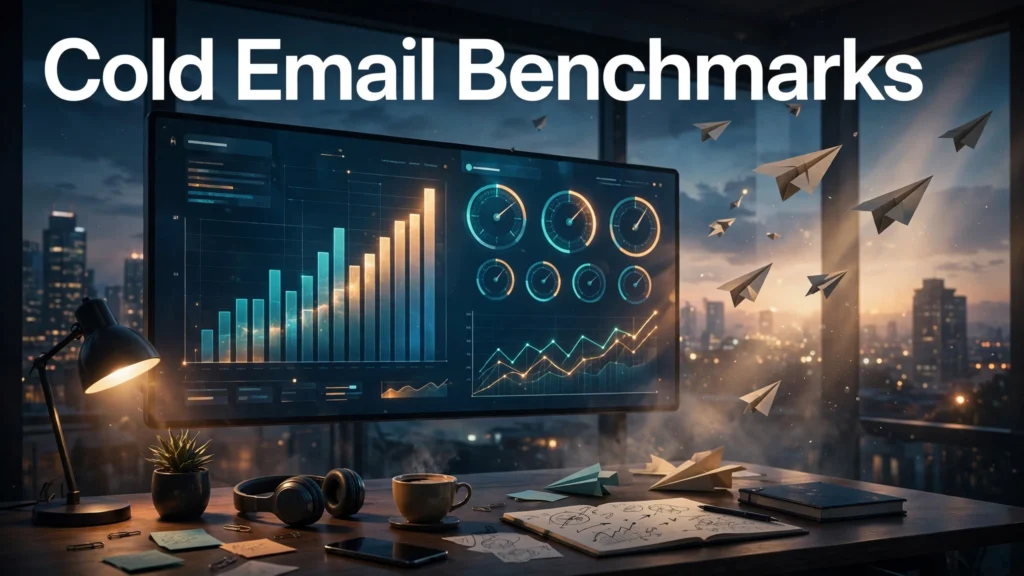
Anchor every decision to benchmarks before changing anything. The table below combines the Instantly 2026 benchmark figures with practitioner data reported by Prospeo. If a metric sits below the average column, fix it before touching copy. Prospeo states the optimization hierarchy plainly: deliverability first, then list quality, then relevance, then the offer, and only then personalization.
| Metric | Average | Top quartile | Elite (top 10 percent) |
|---|---|---|---|
| Reply rate | 3.43 percent | 5.5 percent and up | 10.7 percent and up |
| Open rate | 27 to 42 percent | 45 percent and up | 55 percent and up |
| First-touch replies | 58 percent of all replies | – | – |
| Follow-up replies | 42 percent of all replies | – | – |
| Bounce rate ceiling | Below 3 percent | Below 2 percent | Below 1 percent |
| Spam complaint ceiling | Below 0.3 percent | Below 0.1 percent | Below 0.05 percent |
| Inbox placement, Gmail | 87.2 percent | – | – |
| Inbox placement, Microsoft | 75.6 percent | – | – |
| Meeting booked rate | 0.5 to 2 percent of delivered | – | – |
What Is a Good Cold Email Reply Rate
A reply rate between 3 and 5 percent is normal for cold email in 2026. Five to 10 percent is solid, results that come from tight targeting and verified data. Ten to 15 percent is excellent, and anything above 15 percent is elite. If the rate sits below 2 percent, something structural is broken, and the cause is almost always infrastructure or list quality rather than the subject line. Campaigns with 68 percent open rates and 0.3 percent reply rates have been fixed by rebuilding targeting around intent signals alone, with the same copy. For context on how engagement benchmarks read across channels, see what a good open rate for email marketing looks like, keeping in mind that Apple Mail Privacy Protection inflates open data and reply rate is the metric that matters.
Forty-two percent of all replies come from follow-ups, so a sequence without at least four follow-up touches leaves nearly half of the reply potential on the table. Plan the follow-ups before writing the first email.
What Is the 30/30/50 Rule for Cold Emails
The 30/30/50 rule is a rule of thumb for dividing cold email effort. The most common version, used by Saleshandy and Prospeo, assigns 30 percent of effort to prospect list building and targeting, 30 percent to email copy and message quality, and 50 percent to follow-ups. The percentages deliberately exceed 100, which is the point: they express relative weighting, not a budget split, and they emphasize that most replies come from follow-ups rather than the first email. No published dataset validates any particular allocation, so treat every version as a prioritization guide rather than a formula.
| Version | The 30 | The second 30 | The 50 | Source |
|---|---|---|---|---|
| Effort allocation | Prospect list and targeting | Email copy and message quality | Follow-up sequence | Saleshandy, Prospeo, martal.ca |
| Message anatomy | Personalization | Value proposition | Call to action | emailanalytics.com, no named originator |
The effort-allocation version is the one to use. It tells a team where to spend scarce hours: build the right list, write a decent message, then spend the most energy on the follow-up sequence. The message-anatomy version is harder to defend, since no named study sits behind it, and its 50 percent weight on the call to action contradicts the data showing that the first email carries 58 percent of reply potential while follow-ups carry 42 percent. The Martal cold outreach automation guide frames the 2026 standard the same way: automate the mechanics of list building, signal monitoring, and scheduling, and reserve human effort for the message and the follow-ups.
How to Apply the 30/30/50 Rule This Week
Put the rule to work with one campaign. Spend the first 30 percent on the list: define one ideal customer profile, pull 200 verified contacts, and attach one buying signal to each record. Spend the second 30 percent on the message: write one 60 to 80 word email with the signal in the first line, one result for proof, and one low-friction ask. Spend the final 50 percent on follow-ups: write four short follow-up touches before sending anything, each with a new angle. Send the campaign, then measure positive reply rate by touch. Most teams discover that the follow-ups, not the opener, carried the campaign, which is exactly what the rule predicts.
Signal-Based Outreach: The Replacement for Spray and Pray
Signal-based outreach replaces volume cold outreach with precision outreach timed to observable events in the world of the prospect. Instead of buying a large static list and mailing everyone the same message, the marketer monitors buying signals and sends when the timing makes the email relevant. The concept is documented across 2026 cold email guides, and signal-triggered campaigns are reported at 8 to 12 percent reply rates against a 3.2 percent average positive reply rate. One documented case shows a practitioner at a 68 percent open rate and 0.3 percent reply rate who rebuilt targeting around intent signals and jumped to a 17 percent reply rate with the same copy.
What Are Buying Signals in Cold Outreach
Buying signals are observable events suggesting that a prospect is more likely to engage right now. The table below lists the signals that 2026 guides name most consistently, with examples of how each one becomes an email opener.
| Signal type | Example event | Where to spot it |
|---|---|---|
| Leadership change | New VP of Sales joined this month | LinkedIn, press releases, job announcements |
| Funding round | Series B announced last week | Tech press, Crunchbase, company blog |
| Hiring surge | Three open account executive roles in Chicago | Job boards, careers page |
| Tech stack change | Competitor tool added or dropped | BuiltWith, Wappalyzer, job posts listing tools |
| Product launch or expansion | New product line or new office | Company blog, press, local news |
| Intent data spike | Company researching sales engagement software | Intent data providers, website visit tracking |
| Champion movement | Past customer started a new role elsewhere | CRM history, LinkedIn alerts |
The highest-value signals named by the growleads.io 2026 guide are the new executive hire, an intent spike on category keywords, and a tech stack change, with signal-to-meeting conversion above 5 percent in most B2B verticals. The workflow that practitioners report is simple: monitor the signals, scrape prospect activity such as recent posts and company announcements, store the signal in a CRM field, and generate a one-sentence hook from the signal data. Teams running this workflow report response rates roughly three times higher than their old template-based approach, according to Prospeo.
Cold Email Deliverability in 2026: How to Avoid Spam Filters
Deliverability decides whether the email arrives at all, and it sits at the top of the optimization hierarchy. The Reddit consensus on cold email in 2026, reported by Prospeo, is that performance feels down, but the teams posting strong numbers all share the same pattern: lower volume, more domains, strict sending caps, and obsessive data hygiene. For the full authentication reference, see the bulk sender requirements checklist, since the same rules that govern newsletters now govern cold outreach infrastructure.
Authentication: SPF, DKIM and DMARC on Every Sending Domain
Google classifies a domain as a bulk sender when it sends close to 5,000 or more messages to personal Gmail accounts within a 24-hour period, counting every message from the same primary domain including subdomains. The classification is permanent: one large campaign assigns the bulk sender label and it never expires, according to the official Gmail sender guidelines FAQ. Bulk senders must pass SPF, DKIM, and DMARC with aligned authentication, publish working one-click unsubscribe headers honored within two days, and keep the spam complaint rate below 0.3 percent with a target below 0.1 percent. Since November 2025, Gmail rejects non-compliant mail outright with permanent errors instead of delivering it to spam. Microsoft added stricter authentication expectations for Outlook.com, Hotmail, and Live.com addresses starting in May 2025, making Outlook inboxes among the hardest to reach: Prospeo reports 75.6 percent inbox placement at Microsoft against 87.2 percent at Gmail.
Practical rule for cold email: never send outreach from the primary company domain. Buy dedicated outreach domains, authenticate every one of them with SPF, DKIM, and DMARC, and keep the primary domain far from cold mail so a reputation hit on outreach infrastructure never touches the main brand. Use custom-domain authentication inside the sending tool rather than the default shared setup, because mail signed with the tool domain fails alignment even when SPF and DKIM pass.
Warm-Up and Volume: How Many Cold Emails Per Day Is Safe
Safe cold email volume is far below the provider limits. A warmed inbox should send 20 to 50 cold emails per day, with 25 as the practical ceiling. New mailboxes start at 2 to 10 emails per day. The warm-up period lasts 2 to 4 weeks minimum: start with 5 to 10 plain-text emails per day and ramp to 75 to 100 per day by week three, while full domain maturity can take up to 12 weeks. The infrastructure math that practitioners use is 3 to 5 mailboxes per sending domain, 15 to 25 sends per mailbox per day once warmed, and a minimum 14-day warm-up period. Warm-up is never turned off: it runs continuously to keep engagement signals alive.
If more volume is needed, add inboxes and domains rather than raising the sending rate from a single account. Raising rates from one account is the fastest way to trigger spam filters. Practitioners who scaled from 3 domains to 7, each capped at 26 emails per day, doubled their reply rates. Keep outreach volume to Google Workspace accounts separate in planning: the Google bulk sender rules apply to personal Gmail accounts, not Workspace recipients, but reputation and filtering still apply to B2B sends.
Do not buy or scrape email lists. Verify every address before sending, keep the bounce rate below 2 percent, and treat any list with unknown provenance as a risk to every domain it touches.
List Hygiene: The Fastest Way to Protect the Domain
Sending unverified lists is the single fastest way to destroy a cold email operation. One practitioner reported the bounce rate dropping from 11 percent to under 2 percent after stopping list purchases and verifying every address. Another burned 145 email accounts in a single week after warming them for three weeks, entirely because the list was poor. Keep the bounce rate below 2 percent, treat 3 percent as a red flag threshold, and skip optimization entirely when the bounce rate sits above 5 percent: nothing downstream saves a program with bad data. Verification should catch catch-all domains, spam traps, and honeypots before any send.
Cold Email Law: CAN-SPAM, GDPR and CASL Basics
Cold email is legal in most markets, but the rules differ. In the United States, CAN-SPAM allows unsolicited B2B email with a physical business address in every message, a one-click unsubscribe mechanism, truthful headers, and opt-outs honored within 48 hours; violations can bring fines of 43,792 dollars per email. The European Union permits B2B cold email under GDPR legitimate interest with a documented assessment, while the GrowLeady cold email compliance overview notes GDPR fines reaching 20 million euros for serious violations. Canada is strictest: CASL requires prior consent before commercial email. The practical move for 2026: include the physical address and working unsubscribe in every cold email, keep records of consent where required, and never buy or scrape email lists.
How to Personalize Cold Emails at Scale
Template-level personalization is dead. Spam filters recognize mail-merge first names, and buyers ignore them. Hyper-personalization in 2026 means one specific, timely reference per email: a funding round, a job post, a blog post, or a LinkedIn comment. The Saleshandy test across 12,000 sends, documented in their AI versus human cold email analysis, shows why the writing job needs a human at the end: AI-only emails were flagged by spam filters at 7.8 percent against 2.9 percent for human-written mail. The hybrid setup won on every metric, with a 14.7 percent reply rate and a 3.1 percent spam flag rate. The working conclusion: give AI the research job, keep the writing job with a human, and route every AI draft through a human review step.
The Three Layers of Cold Email Personalization
Lemlist describes three personalization layers in their 2026 personalization guide: surface, segment, and signal. Surface personalization covers the name, company, and title, and it takes minimal effort but moves almost nothing. Segment personalization covers role-specific pain points and industry proof, which suits mid-market outreach with moderate effort. Signal-level personalization references a timely trigger in the opening line or value proposition, and it is the highest-converting layer. A signal-level opener answers two questions in the head of the reader: why this person is emailing, and why today. An email that cannot answer both questions has a signal that is not strong enough. For teams that want AI to carry the research load, AI email personalization covers how predictive and behavioral data feed personalization systems, but the final review stays with a human in cold outreach.
The Follow-Up Sequence That Carries 42 Percent of Replies
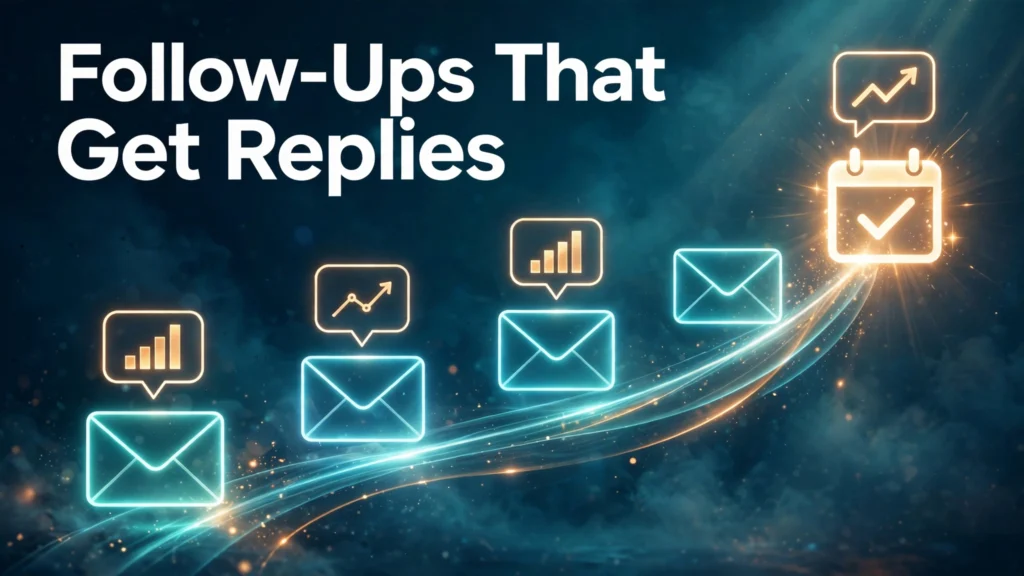
The first email generates 58 percent of all replies, according to the Instantly 2026 benchmark data. The remaining 42 percent come from follow-ups, and teams that stop after two emails leave almost half of their replies on the table. A single follow-up increases replies by 49 to 65.8 percent, and Lemlist benchmarks show that 4 to 7 emails generate three times more responses than 1 to 3 emails. The practitioner sweet spot is 4 to 7 emails over 14 to 21 days. Going past 7 or 8 total emails spikes spam complaints and burns domain reputation for diminishing returns.
A five-touch sequence that practitioners use in 2026 looks like this. Touch one on day zero carries the core value proposition and the call to action, kept under 80 words with one specific observation, one clear value proposition, and one ask. Touch two on day two is a short bump with no new information, written like a reply to the original thread rather than a new email, since reply-style follow-ups outperform formal ones. Touch three on day five adds social proof with one specific customer result expressed in numbers. Touch four on day ten takes a new angle with a resource, a case study, or a different pain point. Touch five on day eighteen is the breakup email, a polite exit that assumes the timing is wrong; breakup emails often generate the strongest reply rates in a sequence because they remove pressure. The Saleshandy 2026 cold email sequence guide documents this cadence with ready examples for each touch.
Two timing rules complete the sequence. First, the best send days are Tuesday through Thursday, with Thursday peaking at a 6.87 percent reply rate in Prospeo data; Monday inboxes are flooded and Friday attention is gone. Second, if there is no reply after the fourth email, stop sending near-daily touches and switch to weekly nurture or end the sequence. Continuing to check in every 48 hours is how senders rack up complaints from people who were never a fit.
Best Cold Email Tools in 2026: What the Categories Do
Cold email tooling in 2026 divides into a few clear categories, and practitioners recommend one tool per function rather than a dozen overlapping subscriptions. The tool list below uses only facts verified on the vendor and practitioner pages, with no pricing figures, since published prices conflict across comparison sites. For the broader platform landscape, see the best email marketing platforms comparison, which covers the newsletter and marketing automation side of the email stack.
Smartlead positions as the AI-driven sender for high-volume agency outbound, with unlimited mailboxes, automatic mailbox rotation, built-in unlimited warm-up, spin syntax, and a master inbox. Instantly positions for volume-per-dollar scale, with unlimited inboxes and warm-ups, inbox rotation, the Unibox centralized inbox, and AI prompts. Woodpecker focuses on automated sequences with A and B testing, follow-ups, built-in warm-up, and conditional advanced sequences. Mailshake covers email sequences with scheduling and send tracking, plus phone and LinkedIn touches and CRM sync for multi-channel motion. Apollo is the all-in-one sales intelligence platform: a prospect database of 275 million plus contacts, a sequencer, a deliverability center, and a Chrome extension. Lemlist built its name on personalization-heavy outreach, with dynamic image and video inserts, AI-generated first lines, and the Lemwarm built-in warm-up. The Instantly 2026 effectiveness guide and the Prospeo 2026 cold emailing playbook both cover the tooling landscape in depth.
Multi-channel sequences deserve a note. Email-only campaigns average 4 to 6 percent response rates, while adding phone and social touches lifts that to 10 to 12 percent, according to Prospeo practitioner data. The compounding effect of coordinated channels is what separates top performers from single-channel programs.
What Results to Expect in the First 90 Days
Cold email is a ramp, not a switch. The table below sets expectations for a new program running on fresh outreach domains with a tight ideal customer profile and verified data.
| Period | Focus | Expected reply rate |
|---|---|---|
| Days 1 to 14 | Domain warm-up only, no campaigns | Not measured yet |
| Days 15 to 30 | First small campaigns, 20 to 30 sends per day | 2 to 5 percent |
| Days 31 to 60 | Copy refinement and signal targeting | 5 to 8 percent |
| Days 61 to 90 | Optimized sequences at steady volume | 8 to 12 percent |
During the first month, the goal is deliverability and domain health, not replies. During the second month, the goal is subject line testing and signal targeting. By the third month, the program runs at steady volume with personalization, unique angles, and list quality as the levers. Teams that follow the ramp report cold email outperforming every other outbound channel within a quarter, while teams that skip the warm-up spend the quarter rebuilding burned domains.
Conclusion
Cold email in 2026 rewards the disciplined and punishes the lazy. The playbook that works is short: build a tight list from real buying signals, authenticate and warm dedicated outreach domains, send 20 to 50 emails per inbox per day, personalize one specific reference per email, route every draft through a human review, and run a 4 to 7 touch follow-up sequence over 14 to 21 days. The 3.43 percent average reply rate is a floor, not a ceiling: teams that follow the playbook reach the 10.7 percent elite tier. Start with one signal, one small campaign, and the infrastructure the mailbox providers demand, and the replies follow.
FAQs
Does cold email still work in 2026
Yes, with a caveat. The Instantly 2026 benchmark report puts the average reply rate at 3.43 percent across billions of cold emails, and the top 10 percent of senders clear 10.7 percent. Generic mass blasts pull 1 to 3 percent and damage sender reputation. Signal-based, personalized outreach with proper deliverability infrastructure reaches 5 to 18 percent. The lazy version of cold email is dead; the disciplined version is thriving.
What is the 30/30/50 rule for cold emails
The most common version assigns 30 percent of effort to prospect list building and targeting, 30 percent to email copy and message quality, and 50 percent to follow-ups. The percentages deliberately exceed 100: they express relative weighting, not a budget split, emphasizing that most replies come from follow-ups. No published dataset validates any particular allocation, so use it as a prioritization guide.
How many cold emails per day is safe
A warmed inbox can send 20 to 50 cold emails per day, with 25 as the practical ceiling. New mailboxes start at 2 to 10 per day. The warm-up lasts 2 to 4 weeks minimum, ramping from 5 to 10 plain-text emails per day to 75 to 100 per day by week three. If more volume is needed, add inboxes and domains rather than raising the sending rate from a single account.
What is a good cold email reply rate
A reply rate between 3 and 5 percent is normal in 2026. Five to 10 percent is solid, 10 to 15 percent is excellent, and anything above 15 percent is elite. Below 2 percent, something structural is broken: fix infrastructure and list quality before rewriting copy. Measure positive reply rate and meetings booked, not open rate, since Apple Mail Privacy Protection makes open data unreliable.
How do I avoid spam filters with cold email
Authenticate every sending domain with SPF, DKIM, and aligned DMARC, warm up inboxes for at least two weeks, and never send from the primary company domain. Keep the bounce rate below 2 percent and the spam complaint rate below 0.1 percent. Have a human review every AI-generated draft, since AI-only emails are flagged by spam filters at 7.8 percent against 2.9 percent for human-written mail in the Saleshandy 12,000-send test.
What are buying signals in cold outreach
Buying signals are observable events suggesting that a prospect is more likely to engage right now: leadership changes, funding rounds, hiring surges, tech stack changes, product launches, intent data spikes, and past champions moving to new companies. Signal-triggered campaigns reach 8 to 12 percent reply rates against a 3.2 percent average positive reply rate. Reference one specific, timely signal per email.