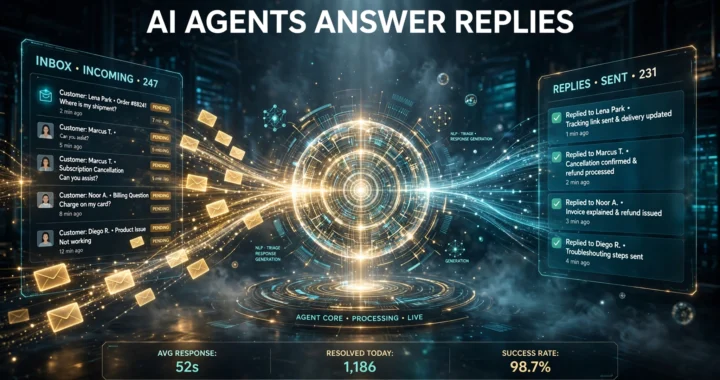
AI email personalization is the use of machine learning inside an email platform to decide who gets what, when it arrives, and which version of the message each recipient sees. The platform predicts the best send time for every contact, scores who is likely to buy or churn, and assembles dynamic email content blocks at send time. The result is personalization far beyond first-name merge tags, delivered automatically at scale.
This guide explains how AI personalization works in 2026, what predictive send-time optimization and churn prediction do in practice, which platforms ship the strongest features, and what the verified benchmarks say about revenue impact. The inbox keeps outperforming newer channels, and our guide on why email marketing still wins explains the revenue case that AI now multiplies.
What Is AI Email Personalization in 2026
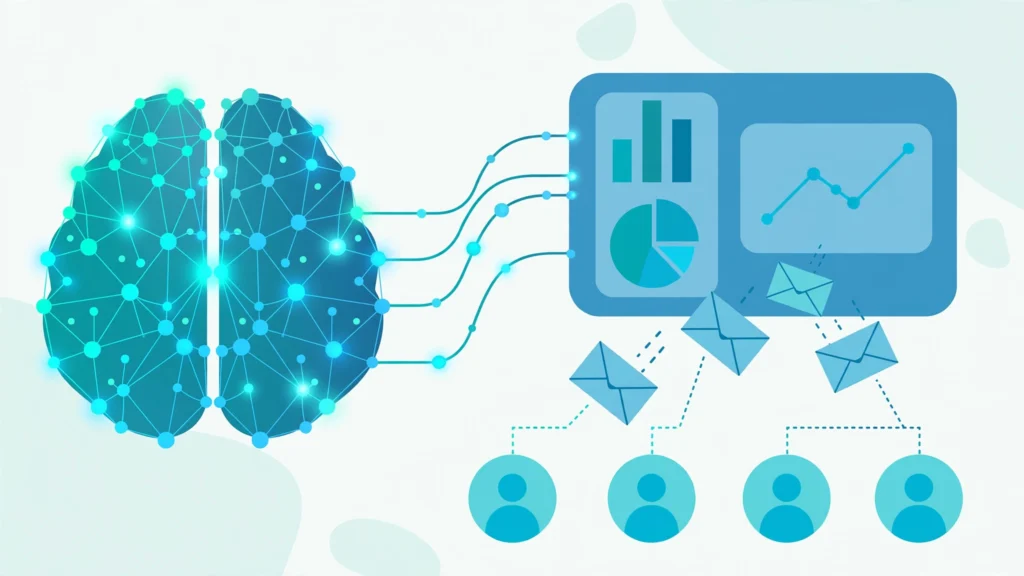
AI email personalization means the email platform uses models trained on subscriber behavior to make three decisions per recipient: timing, targeting, and content. Timing is predictive send-time optimization, which picks the hour each contact is most likely to engage. Targeting is predictive segmentation, which groups contacts by predicted behavior. Content is dynamic, which means blocks inside the email change to match the recipient.
The change from classic personalization is depth. Classic personalization inserts a name, a company, or a product from a rule a marketer wrote. AI personalization predicts behavior from thousands of signals: open and click history, browse behavior, purchase cadence, time of day patterns, category affinity, and price sensitivity. Where merge tags change a few words in a fixed message, AI changes the message itself.
By 2026 the shift is mainstream, not experimental. One benchmark roundup reports that 64 percent of marketers used AI in email by 2026, with personalization as the most common application, and another puts the share of marketers using AI for send-time optimization at 66 percent. Klaviyo, HubSpot, ActiveCampaign, Mailchimp, Brevo, Omnisend, and MailerLite all ship AI personalization features inside the product, most of them on standard plans.
How Does AI Personalize Emails
AI email personalization runs in four steps. First, the platform collects behavioral email targeting signals: opens, clicks, bounces, purchase events, browsing sessions, and form activity. Second, models score each contact on churn risk, predicted customer lifetime value, purchase likelihood, and preferred engagement window. Third, the campaign uses those scores to select segments, set send times, and choose content blocks. Fourth, rendering happens at send or open time, so the version a contact sees reflects the freshest data.
The predictions sit on top of first-party data, which is one reason consent and clean data matter so much. An AI model trained on messy data, duplicate profiles, or broken event tracking will produce confident but wrong predictions. Platforms protect against this with data thresholds: Klaviyo, for example, only shows predictive analytics after an account reaches at least 500 customers with orders, plus 180 days of order history. The gate exists because predictions need a minimum signal before they become useful.
Rendering timing matters too. Some personalization happens at send time, when the platform stamps in the recommended products and content for each recipient. Some happens at open time, when images and blocks update live as the email opens. Open-time rendering keeps recommendations fresh for late openers, which is why dynamic product blocks often pair with it. Marketers tend to adopt the four levers, send-time optimization, predictive segmentation, dynamic content, and generative copy, one at a time, and the strongest results come when the levers run together, as the sections below show.
What Is Predictive Send-Time Optimization
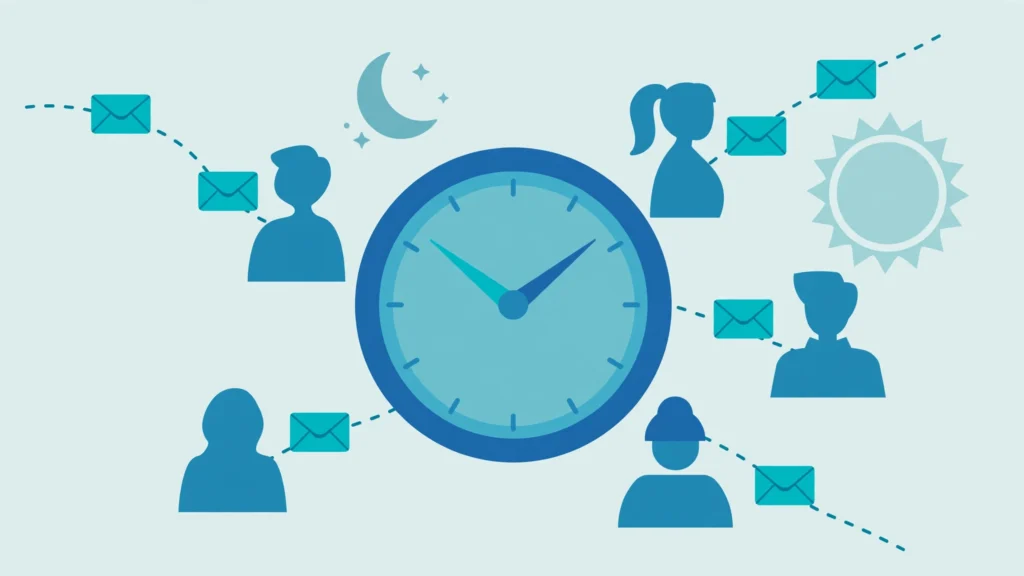
Predictive send-time optimization is a model that chooses the delivery time for each recipient, instead of sending the whole campaign at one fixed hour. It reads the historical engagement patterns of each contact and predicts the window when that contact is most likely to act. The campaign goes out in a staggered wave, with every contact receiving the email at their personal best time.
The lift comes from escaping list-level averages. The old approach picked a time that worked for the majority and accepted that early risers, night owls, and lunch browsers all got a compromise. Contact-level timing removes the compromise: one contact might open emails at 7:15 AM before work, another at 9 PM, and a third at 12:30 PM during lunch, and Predictive Sending assigns each contact the right window automatically.
The benchmarks are strong and consistent. ActiveCampaign reports that its predictive sending improves click-through rates by up to 17 percent. Send-time optimization at the recipient level lifted open rates by an average of 23 percent in one 2026 benchmark, and adding it on top of AI-optimized subject lines added a further 14 percent lift in another.
How the Platforms Implement It
Implementation differs in important ways. The Predictive Sending feature of ActiveCampaign works on both automated workflow emails and one-off broadcast campaigns, and it improves with regular use as the contact-level timing intelligence accumulates. The Send Time Optimization feature of Mailchimp uses data science to find when contacts are most likely to open within 24 hours of the selected send date, is included with the Standard plan or higher, requires a delivery date at least 48 hours in advance, and is not available in automated emails.
Klaviyo ships personalized send time paired with predictive segments, so the timing decision and the audience decision come from the same data. The Aura AI marketing agent of Brevo sets send times inside automations, the Smart Sending feature of MailerLite optimizes delivery times per subscriber, and Seventh Sense plugs AI-powered send-time personalization into HubSpot and Marketo as an add-on.
List-Level vs Contact-Level Timing
Not all send-time tools are equal. List-level tools pick one best time for the audience and send everything at once. Contact-level tools, such as the Predictive Sending feature of ActiveCampaign and the personalized send time of Klaviyo, stagger delivery per recipient. The Mailchimp version sits in the middle: it finds the ideal time within a 24-hour window for recipients, using individual engagement patterns. When comparing platforms, ask whether the tool optimizes per contact or per audience, because that decides how much of the benchmark lift is actually reachable.
Switch send-time optimization on for one send before judging it. The model improves as it accumulates engagement history, so the first send sets the baseline and the fifth send shows the real lift. Judge the trend, not the debut.
Can AI Predict Email Churn
Yes. Churn prediction email models score how likely each customer is to stop buying or stop engaging, usually over a forward window such as the next six months. The score comes from signals such as declining order frequency, shrinking time between orders stretching out, falling email engagement, and browsing that stopped converting. The marketer uses the score to trigger win-back flows, loyalty offers, or re-engagement sequences before the customer goes quiet.
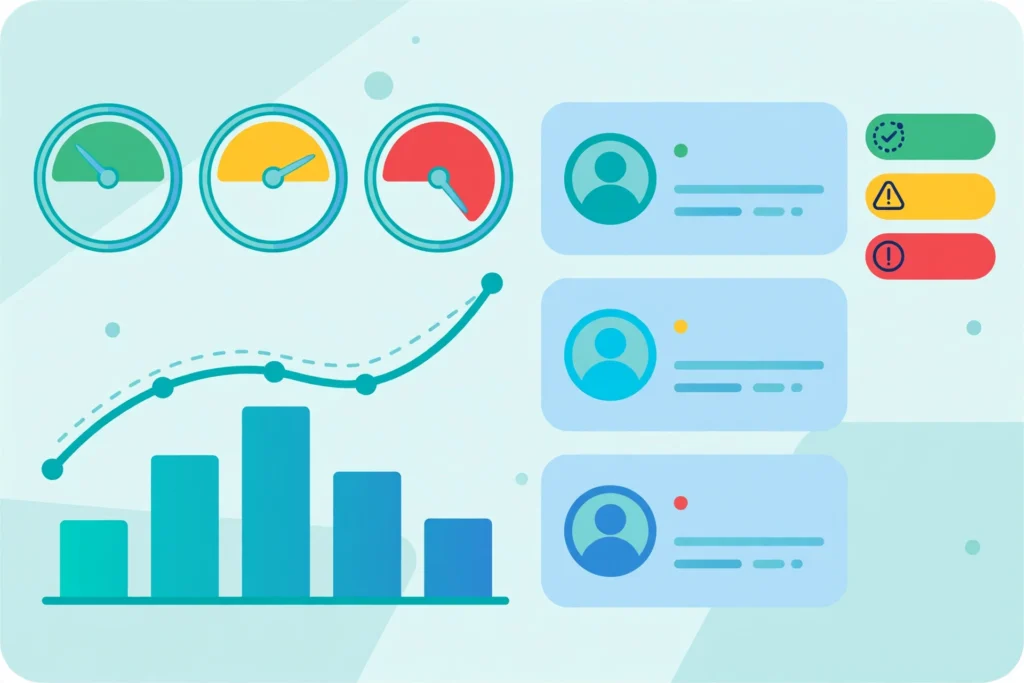
Klaviyo documents the mechanics publicly. Its predictive analytics panel shows a churn risk prediction per profile, color coded by risk level: each new order lowers the probability, while time elapsing between orders raises it. Klaviyo is explicit about the math behind the score, noting that predictions work best averaged over many customers and that the score of a single profile is an estimate, not a certainty. The honest framing matters: churn prediction is a prioritization tool, not a crystal ball.
The platform also predicts the expected date of next order, which turns churn prediction into timing. Instead of a generic win-back blast at 90 days of inactivity, a brand can trigger a replenishment reminder a few days before the predicted next order. Klaviyo advises against counting down to the expected date with the same email sequence every cycle, since repetition drives unsubscribes.
The Predictive Fields Klaviyo Shows Per Profile
The table below lists the predictive fields that appear on a Klaviyo profile once the account meets the data thresholds, with the practical use for each.
| Field | What it predicts | How marketers use it |
|---|---|---|
| Historic CLV | Total value of all previous orders, after refunds and returns | VIP tiers and loyalty rewards for proven high spenders |
| Predicted CLV | How much the customer will spend in the next 12 months | Early access and premium campaigns for future high value contacts |
| Churn risk prediction | Probability the customer stops buying, based on order number and frequency | Win-back flows and save offers for at-risk contacts |
| Expected date of next order | When the customer is likely to purchase again | Replenishment reminders timed to the buying window |
| Average time between orders | Mean gap in days between purchases | Flow delays matched to real purchase cadence |
Data Requirements Before Predictions Appear
Predictions need volume before they work. Klaviyo requires at least 500 customers with orders, an ecommerce integration such as Shopify or WooCommerce, at least 180 days of order history with orders in the last 30 days, and some customers with three or more orders. The CLV model retrains at least once a week on the account data. HubSpot takes the same approach with Breeze AI predictive scoring, which forecasts churn risk, purchase likelihood, and optimal timing from CRM data.
The practical consequence: new stores and small lists should not buy a platform for its predictive features alone. Build the data habit first, and the predictions follow. Churn prediction also pairs with deliverability hygiene: contacts that the model flags as disengaged should often be sunset rather than blasted, and our guide on the bulk sender requirements 2026 explains why sending less to the right audience protects inbox placement.
How to Use AI for Email Segmentation
Manual segmentation builds lists from surface-level filters: opened the last email, purchased in the last 30 days, lives in a certain region. AI email segmentation reads the whole database and surfaces audiences by behavioral patterns that predict conversion, so the marketer stops guessing which filters matter.
The AI-Suggested Segments of ActiveCampaign show the workflow: the platform analyzes the contact database and proposes audiences based on behavioral patterns that predict conversion. One example is a cluster of contacts who opened the last three emails but never clicked, which the model flags as a re-engagement segment needing a stronger call to action rather than another variation of the same message. Another is contacts who browse pricing pages repeatedly without starting a trial, a high-intent segment ready for a demo offer instead of educational content.
HubSpot approaches segmentation through Breeze AI, which offers predictive scoring, segmentation optimization, and content generation inside the marketing platform. The documented value areas are segment ideation, criteria refinement, and predictive insights that forecast churn risk, purchase likelihood, and optimal timing. The HubSpot guidance adds guardrails: verify AI-generated segments against business logic before activation, and test predictive scores on small audiences first.
The revenue case for predictive segmentation is among the strongest in the benchmark data: AI-driven segmentation delivers 18 to 45 percent higher revenue per recipient than demographic segmentation, and a McKinsey finding puts the retail lift at up to 40 percent versus rules-based lists. The pattern is consistent: behavior beats demographics when the model has enough data.
What Are Dynamic Content Blocks and AI Product Recommendations
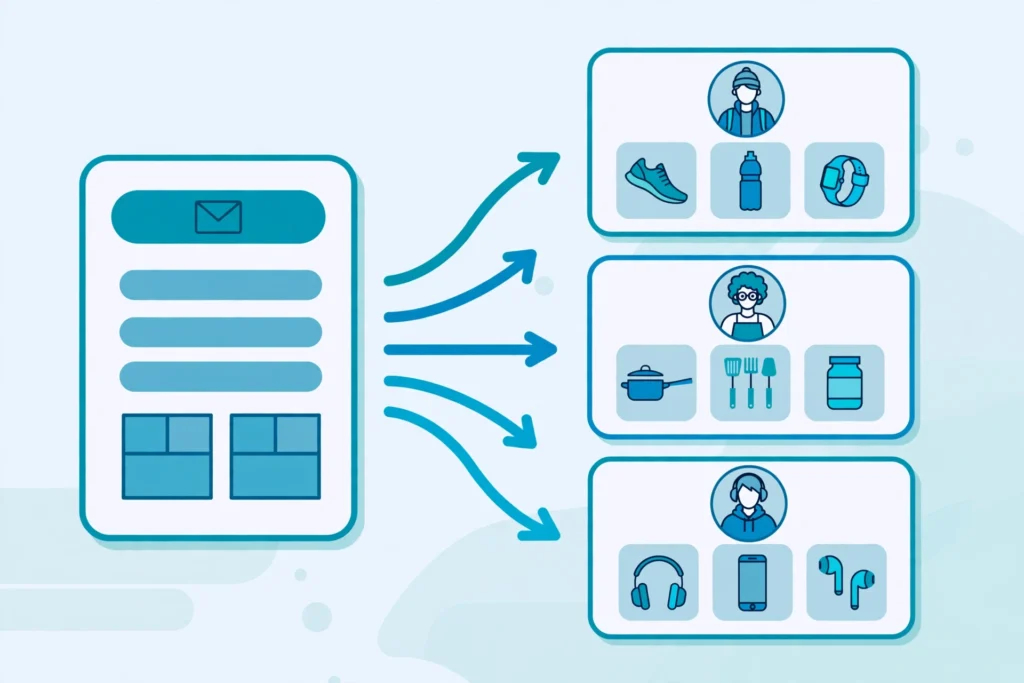
Dynamic email content blocks are sections of an email that change per recipient at render time. The template holds placeholders for a hero image, a set of product tiles, a call to action, or an entire content section, and the platform fills each placeholder with the version predicted to perform best for that contact. AI product recommendations are the most common fill: items chosen from browsing history, purchase history, category affinity, and patterns from similar customers.
Klaviyo data cited in 2026 benchmarks shows AI product recommendations lifting click rates to an average of 3.75 percent, with top-performing brands reaching 8.79 percent. A HubSpot finding puts the click-through lift from AI-powered dynamic content blocks at 32 percent over static blocks. The email stops being one message for ten thousand people and becomes ten thousand messages from one template.
Dynamic content blocks email examples follow a few proven patterns. Abandoned cart blocks show the exact items left behind, plus complementary products. Post-purchase blocks show care guides, accessories, or replenishment options. Re-engagement blocks show bestsellers or new arrivals in the categories the contact browsed. Each pattern pairs one behavioral trigger with one content rule, which keeps the logic explainable even when the fill is automated.
Content Rendered at Send Time vs Open Time
The personalization engine of ActiveCampaign shows how far send-time rendering now goes: one campaign build tailors headlines, product recommendations, calls to action, and whole content blocks to individual contacts automatically, with AI Translations rendering the same campaign in more than 75 languages. The Nurture Agent of HubSpot, released in public beta, takes the same idea further: it changes the content of an automated email at the moment it sends, based on contact data, and marketers can preview the result per contact and lock parts such as the subject line. It costs 10 HubSpot credits per email sent, about ten cents each, so it suits high-value nurture flows rather than bulk blasts.
Open-time rendering is the alternative for content that must stay fresh, such as prices, inventory, and live offers. The practical rule: use send-time personalization for behavioral relevance and open-time rendering for time-sensitive accuracy.
How Do AI Email Subject Lines Work
Personalized subject lines AI tools generate subject lines from behavioral signals, then test and optimize them continuously. The model reads what a contact browsed, bought, or clicked, and drafts lines that reference that context: a product category, a recent cart, a location, or a purchase anniversary. The best tools generate multiple variants and route traffic to winners automatically, turning subject line testing from a manual chore into a background process.
The open-rate evidence is the most replicated finding in AI email benchmarks. A 2026 roundup reports that AI-generated subject lines lift open rates by about 26 percent versus manually written controls, and the Mailchimp email benchmark measured a 19 percent lift across 280 industry cohorts. The numbers differ by study, but the direction never does: AI-written lines beat human-written lines on opens.
The five formulas that keep winning are curiosity, benefit, social proof, urgency, and personalization. The format rules matter as much as the formula: under 50 characters for mobile rendering, under 25 characters for opens and clicks, and 25 to 35 characters for conversions, with at most one emoji. For ecommerce, product-name personalization tokens outperform first-name tokens, which is one more sign that behavior beats demographics. Subject lines tuned with behavioral context also survive AI inbox summaries better, because the summary engines that compress email threads pull from the same relevance signals.
Where Subject Line AI Lives in the Platforms
The Intuit Assist feature of Mailchimp generates subject lines inside the editor, the Aura AI marketing agent of Brevo regenerates and rephrases content there, Omnisend ships subject line and preheader generators on all plans, and the AI Campaign Builder of ActiveCampaign produces subject lines from plain-language goals. The practical advice is to let the AI draft, keep a human review step, and A/B test the winners against your control lines.
Which Platforms Offer the Best AI Email Personalization
No single platform wins every lever. Klaviyo leads on predictive analytics depth, ActiveCampaign on contact-level predictive sending and its Active Intelligence toolset, HubSpot on CRM-aware personalization with the Nurture Agent, and Mailchimp on accessibility for small teams with Intuit Assist and send-time plus send-day optimization.
The comparison table below summarizes the AI personalization strengths of eight platforms from the features verified for this guide.
| Platform | Predictive send time | Predictive segmentation | Dynamic content and recommendations | Best fit |
|---|---|---|---|---|
| Klaviyo | Personalized send time | CLV, churn risk, next order date | Dynamic product blocks and flows | Ecommerce brands with order history |
| ActiveCampaign | Predictive Sending, per contact | AI-Suggested Segments, predictive lead scoring | Personalization engine, 75-plus languages | Automation-heavy B2B and B2C teams |
| HubSpot | CRM-aware send time | Breeze AI predictive scoring | Nurture Agent rewrites content at send time | Teams already on the HubSpot CRM |
| Mailchimp | Send time and send day optimization | Predicted attributes | Pre-built flows with AI content | Small businesses on Standard or higher |
| Brevo | AI send-time optimization per contact | Smart segmentation | Aura AI marketing agent content | Budget multichannel teams |
| Omnisend | Send time optimization | AI segment builder, RFM analysis | Product recommendations, Reports AI | Ecommerce on a mid-tier budget |
| MailerLite | Smart Sending per subscriber | Rule-based with AI assist | AI subject line generator | Creators and simple senders |
| Seventh Sense | AI send-time personalization add-on | Behavioral analytics | Works inside HubSpot and Marketo | Teams keeping their current platform |
Our walkthrough of what is ActiveCampaign explains the automation depth behind its AI features, and our roundup of the best email marketing platforms for 2026 compares pricing and positioning across the field. For teams comparing API depth, our list of the best email API services covers the integration layer.
Does AI Personalization Increase Email Revenue
The short answer is yes, with one condition: the lifts compound when the AI levers run together and stay modest when they run alone. The benchmark table below collects the most cited 2026 figures, with the source for each.
| AI application | Reported lift | Source |
|---|---|---|
| AI-generated subject lines vs manual | About 26 percent higher open rate | 2026 benchmark roundup |
| AI subject lines across 280 industry cohorts | 19 percent higher open rate | Mailchimp email benchmark |
| Send-time optimization at recipient level | 23 percent higher open rate | GetResponse benchmark |
| AI-driven segmentation vs demographic | 18 to 45 percent higher revenue per recipient | 2026 benchmark roundup |
| Predictive segmentation in retail | Up to 40 percent higher revenue per recipient | McKinsey personalization report |
| AI product recommendations in flows | 3.75 percent average click rate, 8.79 percent for top brands | Klaviyo 2026 data |
| AI dynamic content blocks vs static | 32 percent higher click-through rate | HubSpot State of Marketing |
| Full AI workflow across all four levers | 41 percent higher revenue | Salesforce 2026 |
| AI programs vs non-AI programs | 41 percent higher click-through, 20 percent higher conversion | 2026 benchmark roundup |
The Salesforce figure carries an important methodology note, reported in an industry roundup: the 41 percent revenue lift applied to programs running AI across all four core functions, which are audience segmentation, content personalization, subject line optimization, and send-time optimization. Programs using only one or two AI features showed smaller lifts of 8 to 14 percent. Treat vendor-reported numbers as directional, since platforms report their own customers, but every credible 2026 benchmark points the same way: AI integrated across the email workflow compounds into material revenue impact.
Run AI across the full email stack, not on a single lever. Segmentation, content, timing, and subject lines together compound into revenue. One lever alone gives a bump. All four together give a strategy.
AI vs Manual Email Personalization
Manual personalization wins on creative judgment and brand voice control. AI personalization wins on everything that scales: per-contact timing, per-contact content, per-contact segments, and continuous testing. The 2026 answer is AI for scale with human review for judgment. Let AI suggest segments, set send times, fill dynamic blocks, and draft subject lines, while humans keep strategy, creative direction, and final review. The one risk is over-automation without governance: teams that let AI draft and send without review eventually hit a brand voice or compliance wall, and the cleanup costs more than the time saved.
How to Start With AI Email Personalization
Starting well matters more than starting fast. The five steps below apply to any platform.
- Clean the data layer first. Fix duplicate profiles, broken event tracking, and missing purchase events. Predictive models inherit data quality, and consent records must be current before any new targeting begins.
- Turn on send-time optimization for regular campaigns. It is the lowest-effort lever with the most consistent lift, and every major platform ships it. Give the model several sends to accumulate history before judging results.
- Build three predictive segments. High-intent buyers, at-risk churn contacts, and repeat-purchase windows. Review the segments against business logic, then activate them in flows before campaigns.
- Add dynamic blocks to one high-traffic template. Start with product recommendations in the welcome flow or abandoned cart series, where behavioral data is richest and the revenue link is direct.
- Let AI draft subject lines, keep the human review. Generate multiple variants per send, test them against a control, and keep the formulas that win for your audience.
Consent and Privacy Requirements
AI personalization runs on behavioral data, which makes consent the foundation of the whole system. Collect data transparently, honor preference centers, and keep consent records current. Engagement-based filtering now demotes senders that blast disengaged contacts, so the brands that win with AI pair prediction with restraint: predict more, send smarter, and retire contacts the model flags as gone.
Conclusion
AI email personalization in 2026 is no longer an add-on for enterprise teams. Predictive send-time optimization picks the best hour per contact, churn prediction flags at-risk customers before they leave, dynamic email content blocks assemble per-recipient messages from a single template, and AI-written subject lines lift opens by roughly a quarter. Klaviyo, HubSpot, ActiveCampaign, Mailchimp, Brevo, Omnisend, MailerLite, and Seventh Sense all ship these features on standard plans or as affordable add-ons.
The playbook is straightforward: clean the data, turn on send-time optimization, build three predictive segments, add dynamic blocks to one high-traffic template, and let AI draft subject lines under human review. The strongest returns come when the levers run together, with full-stack AI programs reporting revenue lifts around 40 percent. Start with one lever, prove the lift, and compound from there.
FAQs
How does AI personalize emails?
The platform collects behavioral signals such as opens, clicks, purchases, and browsing. Models score each contact on churn risk, predicted customer lifetime value, and preferred engagement window. The campaign uses those scores to set send times, choose segments, and fill dynamic content blocks. Rendering happens at send or open time, so every recipient sees the version predicted to perform best for them.
What is predictive send-time optimization?
It is a model that chooses the delivery time for each recipient instead of sending the whole campaign at one fixed hour. It reads the historical engagement patterns of each contact and predicts the window when that contact is most likely to open and click. ActiveCampaign reports up to 17 percent higher click-through rates from its Predictive Sending, and benchmarks report open-rate lifts of 10 to 23 percent at the recipient level.
Can AI predict email churn?
Yes. Churn prediction models score how likely each customer is to stop buying or engaging, usually over a forward window such as the next six months. Signals include declining order frequency, lengthening gaps between orders, and falling email engagement. Klaviyo documents per-profile churn risk predictions alongside predicted CLV and expected next order date, and the scores work best as a prioritization tool for win-back flows.
How do I use AI for email segmentation?
Start with the suggested segments of the platform, review them against business logic, and test on small audiences before full deployment. Build three segment types first: predicted high-intent buyers for bottom-of-funnel content, at-risk churn contacts for save offers, and repeat-purchase windows for timed reminders. Benchmarks report 18 to 45 percent higher revenue per recipient from AI-driven segmentation versus demographic lists.
Does AI personalization increase email revenue?
Yes, and the lifts compound across levers. Benchmarks report about 26 percent higher open rates from AI subject lines, 18 to 45 percent higher revenue per recipient from AI segmentation, and 32 percent higher click-through from AI dynamic content blocks. A Salesforce study reports 41 percent higher revenue for programs running AI across all four core functions, against 8 to 14 percent for one or two features. Full-stack adoption is what turns a bump into a strategy.
AI vs manual email personalization: which wins?
Neither wins alone. Manual personalization wins on creative judgment and brand voice control, while AI wins on scale: per-contact timing, content, segments, and continuous testing. The 2026 best practice is AI for scale with human review for judgment. Let AI suggest segments, set send times, fill dynamic blocks, and draft subject lines, and keep humans on strategy, creative direction, and final review.