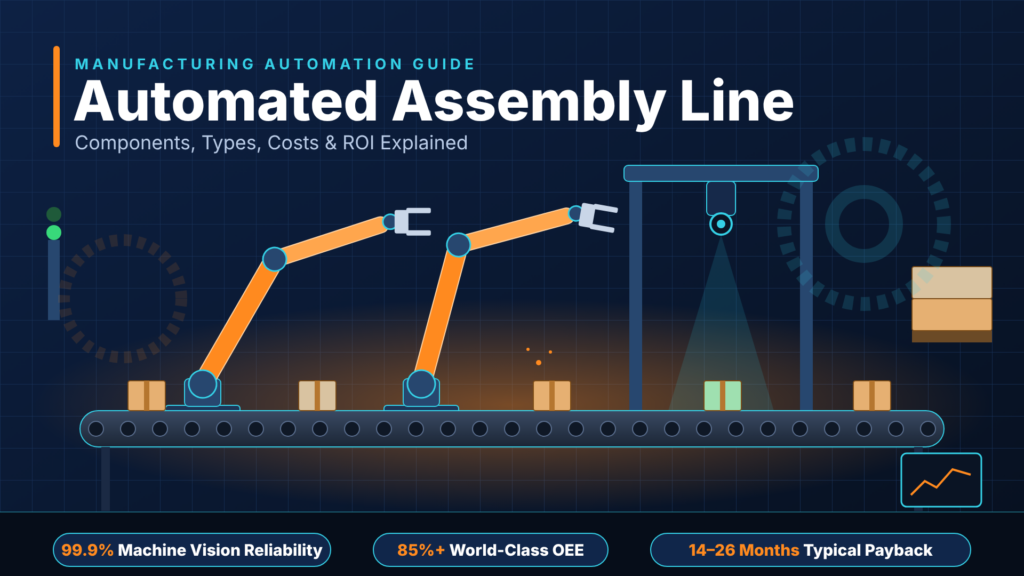
Quick Answer: An automated assembly line is a sequential manufacturing system where robotic arms, automated conveyors, parts feeders, and programmable logic controllers (PLCs) assemble components with minimal manual labor. It standardizes cycle times, reduces defect rates down to parts-per-million levels ($C_{pk} \ge 1.67$), and typically delivers full investment payback within 14 to 26 months.
Manual assembly bottlenecks, rising labor overhead, and inconsistent part tolerances frequently throttle production output for manufacturing operations. Deploying a well-engineered automated assembly line transforms these operational headaches into predictable cycle times and traceable quality metrics. This guide details how modern automated assembly systems operate, breaks down mechanical and robotic components, compares equipment architectures, and calculates realistic capital investment payback periods.
What Is an Automated Assembly Line and How Does It Work?
An automated assembly line is a sequential manufacturing configuration where specialized machinery, automated transfer mechanisms, and robotic workstations assemble subcomponents into a completed product with minimal direct manual intervention. Workpieces travel systematically along dedicated stations that perform repeatable mechanical fastening, joining, dispensing, and inspection operations at predefined cycle rates.
Modern automated assembly lines replace manual handling with deterministic workflow pacing. Centralized controllers monitor line status, synchronize station cycles, and automatically reject defective units without halting overall production.
The Core 5-Stage Workflow: From Infeed to Packaging
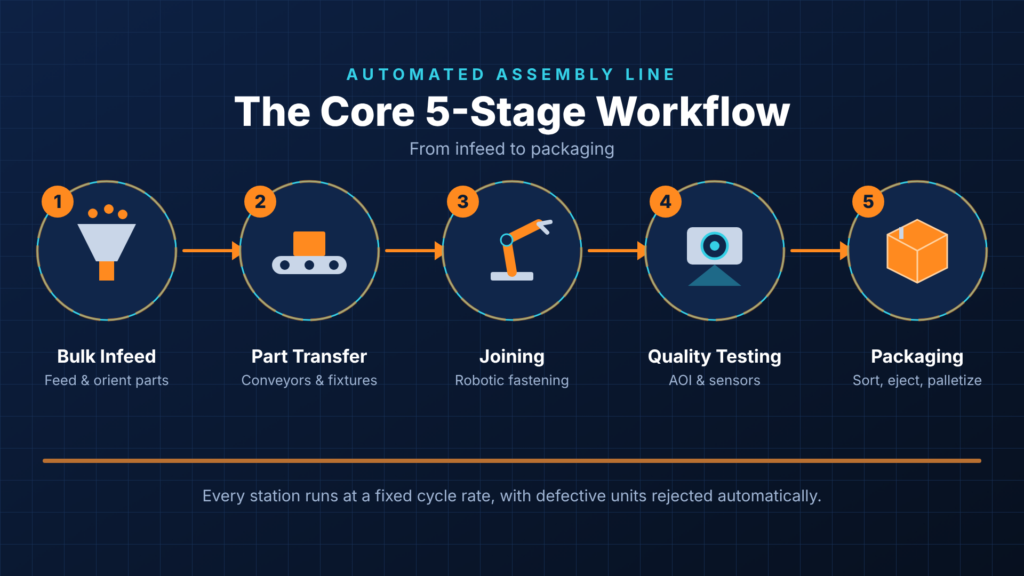
A standard automated assembly line organizes production into five discrete mechanical and digital stages:
- Bulk Infeed and Orientation: Raw subcomponents enter the system via vibratory hoppers, step feeders, or bulk bins. Mechanical escapements or vision systems orient each component so grippers can acquire parts at precise spatial coordinates.
- Sequential Part Transfer: Conveyors, walking beams, or rotary dial tables transport the primary workpiece fixture between operational workstations.
- Automated Joining and Fastening: Dedicated robotic arms or mechanical actuators complete tasks like screw driving, ultrasonic welding, press-fitting, riveting, or precision adhesive dispensing.
- In-Line Quality Testing: Automated optical inspection (AOI) cameras, laser profilers, and force-displacement sensors verify dimensions, verify torque thresholds, and test electrical continuity.
- Ejection, Sorting, and Offloading: Verified acceptable units move down the line to automated packaging or palletizing, while rejected assemblies divert into quarantined lockboxes for root-cause analysis.
Continuous Movement vs. Indexing Transfer Lines
Choosing the right transport motion governs your automated assembly line cycle capability:
- Continuous Flow Systems: Workpieces move steadily without stopping. Robotic manipulators synchronize their travel speed directly with the conveyor tracking encoder to perform dispensing or light fastener placement on the fly. This architecture suits high-speed packaging, bottling, and high-volume consumer goods.
- Intermittent (Indexing) Systems: The transfer conveyor moves fixtures rapidly, stops them at fixed station stops, clamps them into micro-tolerance locating nests, and dwells while high-force operations occur. Indexing is necessary for pressing bearings, torquing fasteners, and high-resolution camera inspections where vibration must equal zero.
5 Essential Components That Power Assembly Line Automation
Every high-performance automated assembly line depends on an integrated ecosystem of mechanical, optical, and computational hardware.
1. Material Transfer Systems: Modular Conveyors, AGVs, and AMRs
The circulatory system of any automated assembly line is its transfer mechanism. Modern plants rely on modular pallet conveyors with friction-top rollers that allow pallets to accumulate without scuffing finished surfaces. For facilities running flexible layouts, Autonomous Mobile Robots (AMRs) and Automated Guided Vehicles (AGVs) transport work-in-progress (WIP) batches directly between independent automated assembly cells.
2. Industrial Robotics and Collaborative Cobots
Robotic arms execute high-dexterity manipulation that fixed tooling cannot manage. High-speed SCARA (Selective Compliance Articulated Robot Arm) units handle rapid pick-and-place insertions with repeatability down to $\pm 0.01\text{ mm}$. Six-axis articulated robots manage complex trajectories such as seam sealing and flame treating. Meanwhile, collaborative robots (cobots) equipped with integrated torque sensors operate alongside personnel without safety cages. For engineers configuring these units, mastering dedicated robotics programming ensures arm trajectories, speed profiles, and acceleration curves remain smooth and collision-free.
3. Precision Parts Feeding: Vibratory Bowls vs. Vision-Guided Flex Feeders
Feeding hardware supplies fasteners and housings to the line. Conventional vibratory bowl feeders use tuned electromagnetic coils and mechanical track tooling to orient symmetrical hardware at high speeds. When assemblies use delicate or variable geometries, modern plants switch to flexible feeders. These systems vibrate bulk components onto flat backlighted surfaces where overhead cameras locate good parts, directing robotic arms to pick them regardless of raw orientation.
4. Automated Optical Inspection (AOI) and Machine Vision
Human visual inspection rarely exceeds 85% defect capture over long shifts. Machine vision systems on an automated assembly line achieve 99.9% reliability. High-resolution industrial cameras paired with telecentric lenses check component presence, verify color coding, measure gap tolerances, and read 2D DataMatrix serial codes within milliseconds. Parts failing visual checks trigger pneumatic diverters that pull non-compliant items instantly off the automated assembly line. When integrating deep learning models for complex surface defect recognition, establishing a structured AI governance framework helps engineering teams maintain data integrity and model drift oversight.
5. Control Architecture: PLCs, HMIs, and SCADA Integration
The brain behind the automated assembly line is the industrial Programmable Logic Controller (PLC). PLCs execute ladder logic within deterministic millisecond scan times, managing fieldbus communications over Profinet, EtherCAT, or Ethernet/IP. Line operators interact with graphical Human-Machine Interfaces (HMIs) to view recipe parameters, acknowledge alarms, and observe cycle time trends. Partnering with experienced teams in IoT development allows manufacturers to stream raw PLC telemetry directly into enterprise SCADA and MES dashboards for historical line tracking.
Types of Automated Assembly Lines: Which Fits Your Volume?
Selecting an inappropriate automated assembly line architecture can burden a plant with excessive setup times or stranded capital. Manufacturing operations generally categorize systems into three operational tiers.
1. Dedicated Hard Automation Lines
Dedicated systems are custom-built to manufacture a single product design at maximum output rates. Stations rely on cam-driven mechanisms and dedicated mechanical fixtures rather than reprogrammable robots. While dedicated lines demand the highest upfront capital, they deliver cycle times under three seconds per unit. They are the standard for automotive spark plugs, medical syringes, and consumer electronics components.
2. Flexible Assembly Systems (FAS)
A flexible automated assembly line uses programmable multi-axis robots, servo-driven positioning nests, and automatic quick-change End-of-Arm Tooling (EOAT). Optical barcode scanners read pallet RFID tags at the station entrance, automatically loading the correct assembly sequence and tightening torque recipes. Flexible lines accommodate multiple product variations on the same physical line without costly physical retooling.
3. Semi-Automated Hybrid Workstations
Semi-automated architectures blend manual labor with automated machinery. Human technicians perform tactile, non-standard insertions, while machines handle repetitive high-torque fastening, press operations, and hazardous chemical dispensing. Adhering to verified NIST guidelines during workstation design guarantees human-robot safety and structural station ergonomics across shared assembly zones.
Comparison Matrix: Manual vs. Semi-Automated vs. Fully Automated
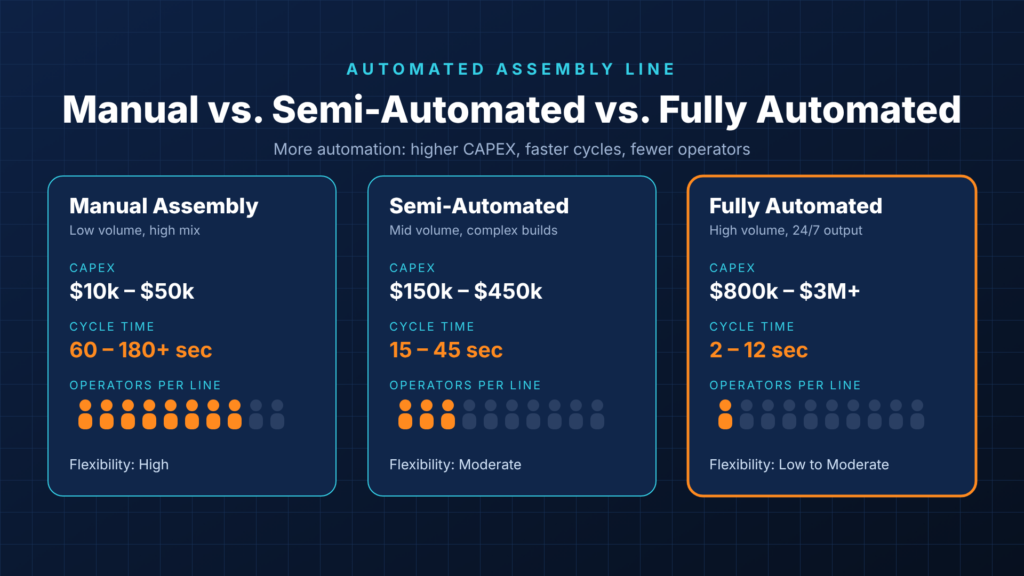
| Automation Classification | Capital Investment (CAPEX) | Average Cycle Time | Line Flexibility | Labor Requirements | Ideal Application |
| Manual Assembly | Low ($10k – $50k) | 60 – 180+ sec | High (Instant re-tasking) | High (3–10 operators/line) | Low volume, high mix, custom prototyping |
| Semi-Automated Line | Moderate ($150k – $450k) | 15 – 45 sec | Moderate (Recipe changeovers) | Medium (1–3 operators/cell) | Mid volume, complex assemblies, sub-assemblies |
| Fully Automated Line | High ($800k – $3M+) | 2 – 12 sec | Low to Moderate (Robotic tooling) | Low (1 roving technician) | High volume, standardized products, 24/7 output |
The Real Cost of an Automated Assembly Line: CAPEX, OPEX, and ROI
Evaluating an automated assembly line requires examining total lifecycle cost rather than just initial purchase quotes.
Estimated Capital Expenditure (CAPEX) by Project Scale
- Standalone Robotic Cell ($80,000 – $250,000): Single articulated arm or cobot station handling dedicated screwdriving, adhesive dispensing, or end-of-line palletizing.
- Integrated Multi-Station Automated Assembly Line ($500,000 – $1,500,000): 4 to 8 automated stations with pallet conveyors, automated part feeders, PLC controls, safety light curtains, and integrated vision inspection.
- Turnkey High-Speed Industrial Line ($2,000,000 – $5,000,000+): Full-scale factory installation with redundant feed systems, multi-robot coordination, cleanroom compliance, and complete MES data connectivity.
Operational Expenses (OPEX) Considerations
Routine operational expenses for an automated assembly line include:
- Tooling Wear and Consumables: Vacuum suction cups, gripper fingers, pneumatic seals, and drive belts requiring scheduled replacements.
- Preventive Maintenance: Sensor calibration, mechanical lubrication, and vision lens cleaning.
- Technical Labor Overhead: Retaining skilled controls engineers and automation technicians capable of debugging fieldbus faults and modifying PLC code.
Calculating the Automation Payback Period
Justifying capital expenditure requires modeling direct labor reductions, scrap minimization, and line throughput gains against amortized investment. Reviewing core tenets of process automation helps financial teams map operational workflows before calculating financial yields:
$$\text{Payback Period (Years)} = \frac{\text{Total Installed CAPEX}}{\text{Annual Gross Operational Savings} – \text{Annual Maintenance OPEX}}$$
Where annual gross savings equal:
$$\text{Labor Displacement Savings} + \text{Scrap Reduction Value} + \text{Increased Production Margin}$$
A balanced automated assembly line installation typically yields full capital recovery within 14 to 26 months of steady operation.
Critical Manufacturing KPIs: Measuring Line Efficiency and OEE
Operating a high-yield automated assembly line demands disciplined performance tracking against core manufacturing metrics.
Takt Time vs. Machine Cycle Time
Takt time represents the pace required to satisfy customer demand:
$$\text{Takt Time} = \frac{\text{Net Available Production Time}}{\text{Customer Demand Quantity}}$$
For an automated assembly line to avoid production shortfalls, individual station cycle times must register roughly 10% to 15% faster than customer takt time. This buffer accommodates minor part replenishment pauses and scheduled tool adjustments.
Overall Equipment Effectiveness (OEE) Benchmarks
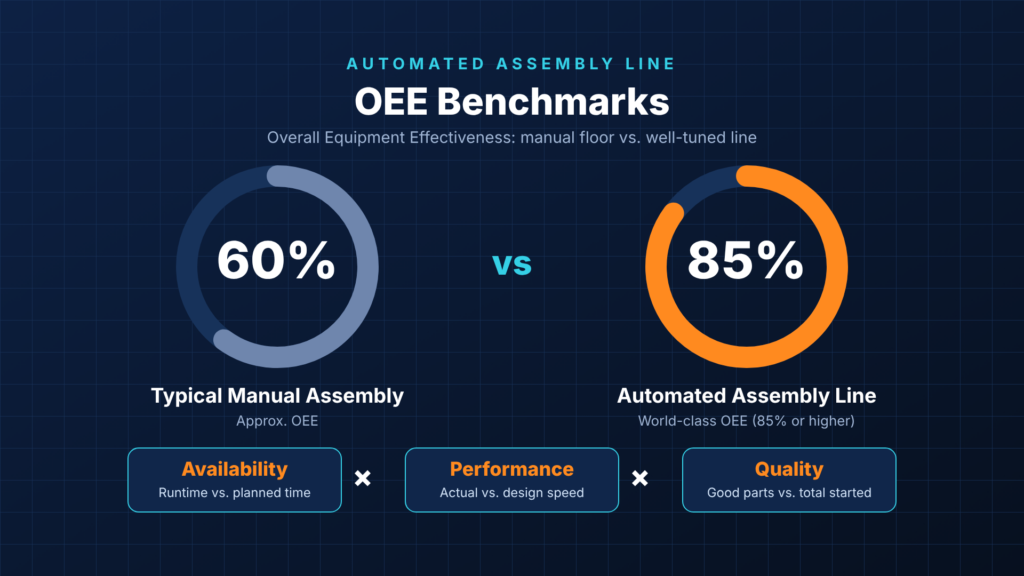
OEE evaluates three operational dimensions of an automated assembly line:
$$\text{OEE} = \text{Availability} \times \text{Performance} \times \text{Quality}$$
- Availability: Ratio of actual runtime to planned production time (monitoring unplanned downtime).
- Performance: Realized speed versus design nameplate cycle speed.
- Quality: Good parts produced divided by total parts started.
While typical manual assembly floors register OEE scores near 60%, a well-tuned automated assembly line routinely hits world-class benchmarks of 85% or higher.
Statistical Process Capability ($C_{pk}$ and $P_{pk} \ge 1.67$)
Automation minimizes variation. Maintaining process capability indices ($C_{pk}$) at or above 1.67 ensures dimensional consistency within parts-per-million defect thresholds, satisfying strict ISO and automotive tier-one supplier mandates.
The Hidden Engineering Challenge: Infeed Tolerances and Feeding Jams
The primary point of failure on any new automated assembly line rarely involves robotics or control code. Instead, inconsistent raw material tolerances cause catastrophic feeding stoppages.
Why Part Dimensional Variation Shuts Down Automated Lines
Human assemblers unconsciously compensate for small manufacturing flaws: they flex a plastic tab, push past a slight burr, or reposition an off-center washer. An automated assembly line cannot make instinctive adjustments unless programmed to do so. When stamped or molded subcomponents arrive with dimensional drift outside blueprint tolerances, parts lodge inside vibratory feeder tracks or bind inside precision fixtures, triggering automated line faults.
Prevention: Poka-Yoke Fixturing and Vision Gating
- Upstream Vendor Tightening: Require component suppliers to certify process capability data before delivering bulk parts.
- Mechanical Poka-Yoke (Mistake-Proofing): Install mechanical wiper gates and relief cutouts along feeder rails that physically drop misshapen parts out of the feed line before they reach assembly nests.
- Pre-Assembly Vision Gating: Use fast 2D silhouette cameras above pick points to verify critical dimensions. If an incoming part exceeds tolerance boundaries, the robot bypasses the component and flags the operator.
Step-by-Step Implementation: From Engineering to FAT & SAT
Deploying an automated assembly line successfully requires a structured systems-engineering methodology.
Phase 1: Conceptual Design and Cycle Simulation
Integrators conduct detailed process audits, defining parts lists, cycle budgets, and station counts. Engineers build 3D digital twins to simulate robotic reaches, conveyor clearance, and cycle bottlenecks before cutting steel. Evaluating emerging tech trends helps manufacturing leaders incorporate virtual commissioning and real-time physics engines into initial planning.
Phase 2: Detailed Mechanical, Electrical, and Pneumatic Design
Engineering teams draft CAD models, compile Bill of Materials (BOM), create electrical schematics, program PLC logic, and design custom End-of-Arm Tooling.
Phase 3: Factory Acceptance Testing (FAT)
Before releasing equipment from the integrator’s facility, the automated assembly line undergoes exhaustive validation. Teams run test batches of actual production parts at full speed to verify cycle times, safety interlocks, error-recovery routines, and scrap diverters. Equipment ships only after hitting agreed acceptance criteria.
Phase 4: Installation and Site Acceptance Testing (SAT)
Integrators mount, align, and wire the automated assembly line on the customer’s production floor. Technicians connect plant utilities (compressed air, 480V power, industrial network drops) and run multi-day trial production under real factory conditions.
Phase 5: Workforce Training and Production Ramp
Plant maintenance technicians and line leaders undergo rigorous instruction on fault recovery, recipe adjustments, sensor calibration, and preventive maintenance routines to safeguard long-term line uptime.
Frequently Asked Questions About Automated Assembly Lines
What is an automated assembly system?
An automated assembly system is an integrated production arrangement combining robotic manipulators, parts-feeding devices, mechanical conveyors, and programmable logic controllers. It systematically feeds, aligns, fastens, and inspects parts into a completed assembly with minimal manual intervention, ensuring consistent cycle times and high repeatability.
What are the four main types of assembly lines?
The four primary configurations are:
Manual lines: Hand assembly supported by basic fixtures.
Semi-automated lines: Combined manual stations and robotic equipment.
Flexible assembly systems: Programmable lines accommodating multi-model variants with fast changeover.
Dedicated automated lines: High-speed hard-automation systems engineered to mass-produce a single product design.
What is an automated production line?
An automated production line covers the comprehensive, end-to-end manufacturing process transforming raw material into packaged goods through machining, forming, treating, assembling, and boxing. In contrast, an automated assembly line focuses specifically on the mechanical joining and inspection of pre-fabricated parts.
What are the 5 basic components of an automated system?
An industrial automated system relies on:
Actuators and drives: Motors and cylinders producing physical motion.
Sensors and inspection: Vision cameras and proximity switches reading physical states.
Control processor: PLCs and industrial PCs executing operating code.
Tooling and robotics: Grippers and end-effectors physically assembling workpieces.
Transfer mechanisms: Conveyors, walking beams, or mobile robots shuttling components.
Is automation good or bad?
Industrial automation is overwhelmingly beneficial for productivity, defect reduction, and worker safety, removing operators from repetitive stress and dangerous manufacturing operations. However, it requires significant upfront capital investment, demands skilled controls technicians for maintenance, and necessitates strict component quality control to avoid feeding stoppages.
Modernizing Your Production Floor
Upgrading from manual production to a high-throughput automated assembly line requires methodical planning, robust tooling design, and strict component quality control. Rather than attempting a high-risk full-facility overhaul overnight, experienced plant managers systematically identify primary line bottlenecks or high-scrap stations, implementing modular automated cells first. This progressive transition stabilizes cash flow, builds internal technical expertise, and delivers measurable ROI from day one.